Friday, April 03, 2015

No frigates, indeed

Sometimes when I'm caught up in the dramas of murder mysteries, I forget what day of the week it is or what time I need to wake up the next morning.

I didn't mean to read a book about Passover and Easter during Holy Week, but that's how the reservation queue at the library worked out. Though it's described as a novel, The Fifth Servant feels like the first book in a mystery series. A murder mystery that takes place in Prague's ghetto in the late 16th century, it features a Polish scholar as the outsider who investigates the crime. There were a lot of Talmudic side conversations and musings about life and faith and persecution, and the mystery itself was a good one. The end of the book wasn't very satisfying, in that so many interesting characters had only minor parts. And the half 1st-person, half 3rd-person narrative kept throwing me off.

When I got curious about what might be left of the old Jewish quarter of Prague, a few minutes on  wikipedia told me that basically half the events in Wishnia's book are inspired by real-life people or tales. That made me realize what was missing that would have tied up the loose ends for me: an afterword or notes on the history and research behind the characters and the historical events.

But I finally caught up on the two most recent installments in my favorite, favorite, favorite murder mystery series (or one of them, anyway). The Dead in Their Vaulted Arches has our adorable evil genius detective faced with two new challenges: solving her own mother's decade-old murder, and dealing with her initiation into her family's long tradition of being master spies. Which is AWESOME.

As Chimney Sweepers Come to Dust has our heroine shipped off to boarding school in Canada to follow in her famous mother's footsteps and continue her secret agent training.

I really, really, really don't want to wait more than a year for the next installment, but I know time flies and when nerd child detective Flavia de Luce appears in her next book, it will seem like no time has passed at all!

In the meantime, there are other frigates...

Sunday, March 15, 2015

Unfinished business: Movies

I've been binge-watching shows on Netflix and Amazon lately, instead of watching movies online. However, I've seen a surprising number of movies in actual theatres in the past few months.

I wasn't the biggest fan of Wild the book, and I was less a fan of the movie. For starters, I don't think Reese Witherspoon was the right actress to play Cheryl Strayed: she's too delicate-looking and tiny and wholesome-seeming. The movie also left out quite a lot of the book that detracted from Strayed's personal journey. Her ex-husband's role in the movie is reduced to a simply supportive character rather than a best friend who becomes a casualty of her grief and rage; her stepfather is completely absent; her mother comes across as flighty instead of complex.  I really don't know how this got nominated for Best Picture.

Fury was a pretty by-the-book WWII movie. I grew up watching them, so it was fairly predictable. The audience is initiated into the horrors of war through the experience of the young soldier who wasn't supposed to be on the front lines: he has to be taught to kill, has to be shown by his commanding officer how to interact with civilians amid chaos,  has to learn how to be part of a team in order to survive. It wasn't the greatest or most poignant war movie (though it tried to be), but it was a decent addition to the genre.

Dear White People was a movie I would have really related to when I was 21 or 22. Because it definitely reads like it was written by people fresh out of an elite private college. (It's clearly supposed to take place at a Harvard clone.) The basic plot revolves around a largely white fraternity hosting a racist Halloween party, and the events that lead up to it: attempts by the college administration to get rid of a historically all-black dorm, the role of money in higher education, and media depictions of blackness. The film attempts to explore nuances of African-American identity, which I as someone who isn't black don't feel I can critique as heavily; I feel I can say, however, that that is the most intriguing part of the movie. It reminded me of Spike Lee's Bamboozled, but set on a college campus and filled with angsty young adults trying find themselves amidst a cloud of hormones, historical race relations, and the influence of money. I left the theatre with long-buried, unsettling flashbacks to my own college experience, but feeling that the movie tried too hard with too much material. It could have been a more powerful statement on race in higher education. In the moment, I appreciated certain scenes in the movie; but stepping back it was barely even a surface-scratching look at a very serious set of issues.

Mi Hermana and I ran out to watch the third movie in the Hunger Games series. As a huge fan of the books, I was a huge fan of this movie. The third book in the trilogy is split into two movies, and Mockingjay: Part I was pretty amazing. Friends who saw it before me told me that the communications team (following Katniss around bombed-out areas of Districts supporting her revolution) reminded them of me, which is rather flattering but funny. And weeks after seeing the movie, I was a little horrified to hear the remixed version of Katniss' inspiring a cappella call to revolution: "The Hanging Tree" all beat-ified is actually playing on mainstream radio stations.

Mi Hermana, who hasn't read the HG books, was highly disturbed by the scenes of Peeta's psychological struggles. She said she's been watching too much Dora the Explorer, Super Why, and My Little Ponies in the past few years to dive full-scale into a movie about violently overthrowing an oppressive system...

... and yet she was completely fine watching The Eagle, a highly forgettable movie about the 9th Legion in Britain. We watched it on Netflix back-to-back with Centurion, so we might have overdosed on B-quality films about the famous Roman legion lost to time somewhere in the mists of Scotland. The unexpected role of Jamie Bell (who we last saw in Billy Elliott) was one of the only highlights. Like most stories about Roman Britain, it had to bridge the political and cultural divide between occupier and occupied with some sort of hint that the eventual melding of the two would solidify into what we now see as the indomitable British bulldog spirit.

While I was critiquing the history, Mi Hermana the linguist was critiquing the lack of adequate explanations as to how all the different characters from the polyglot Empire were actually communicating.

Fun times.

Friday, March 13, 2015

O me! O life!

A little late with the New Year's reflections, but it's still pretty close to Chinese New Year so I figure I'm only kind of tardy.

Notable "firsts" in 2014:
  • My first mountain summit outside the United States
    It rained cats and dogs on me most of the time, but I loved every minute of it. Mt Snowdon kicked off my solo Welsh hiking trip -- and infected me with the destination hiking bug. If all goes well in 2015, I'll be on to two more international summits!
  • My first Sounders fan trip outside Seattle - to Canada! 
    There was a lot of unanticipated drinking involved. I had packed a nice little sandwich and nalgene bottle for the bus ride up to Vancouver, and was completely unprepared for the total boozefest that the 16-hour adventure turned out to be.
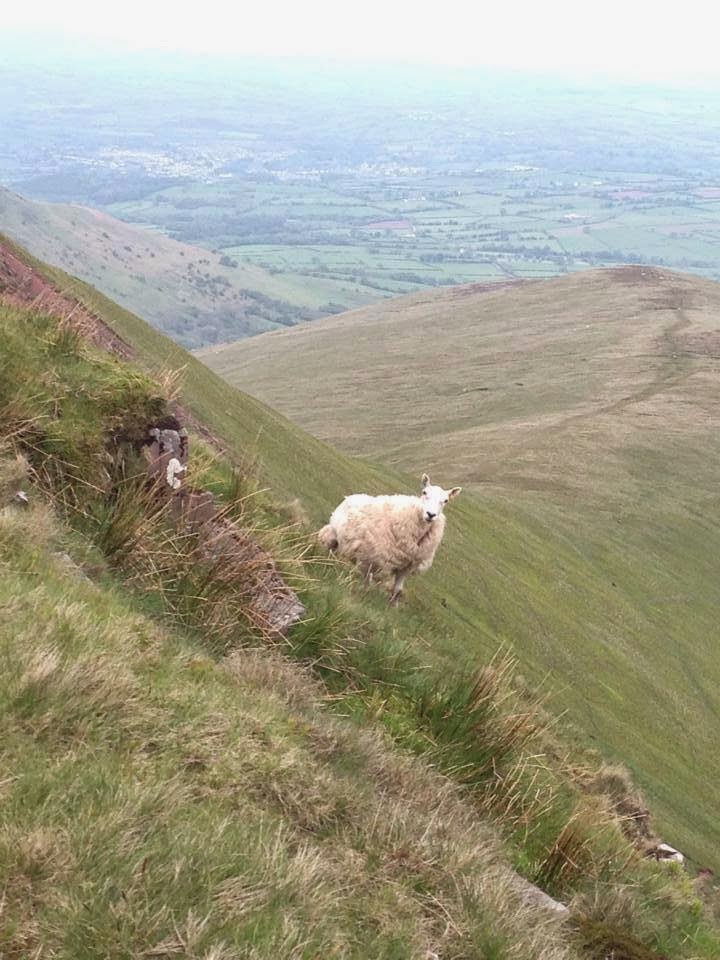
  • I swear, sheep can stand sideways. This one
    was in the Brecon Beacons on my toughest
    hiking day, which included 4 summits.
  • My first 10K!
    This experience also came with my first taste of GU gel at the halfway mark, which was kind of gross but did indeed provide an extra sugar boost. The course was completely flat, which helped.
  • First trip to Dallas
    I was at a conference for work. Got to see the JFK memorial and a few other touristy sights in downtown Dallas.
  • First time going to a roller derby match
    Or whatever they're called. The rules are still somewhat of an enigma, but it was still fun to watch a new sport.
  • First time camping on a beach
    Not just any beach -- the ocean! The Pacific Ocean!  Our campsite was mere yards away from the shore. A cacophany of barking seals kept us up all night. It was awesome. We had to hike three miles across sand during low tide  -- and then I actually volunteered to walk an extra six miles when we ran out of wine -- but it was worth it.
2014 was pretty cool. Here's to 2015 and the Year of the Sheep, and all the "firsts" in store!

Oh me! Oh life! of the questions of these recurring,
Of the endless trains of the faithless, of cities fill’d with the foolish,
Of myself forever reproaching myself, (for who more foolish than I, and who more faithless?)
Of eyes that vainly crave the light, of the objects mean, of the struggle ever renew’d,
Of the poor results of all, of the plodding and sordid crowds I see around me,
Of the empty and useless years of the rest, with the rest me intertwined,
The question, O me! so sad, recurring—What good amid these, O me, O life?
                                       Answer.
That you are here—that life exists and identity,
That the powerful play goes on, and you may contribute a verse.
                                             -- Walt Whitman 
 

Thursday, January 01, 2015

Unfinished business: Books

2014 was a whirlwind, but a year in which I developed my strongest coping mechanisms yet for managing anxiety. I'm proud of myself for working hard to do that -- even if it meant declining happy hours with friends or taking naps and accidentally oversleeping for soccer games.

The projection for 2015 so far is pretty awesome: new season ticket seats for Sounders FC games, hiking the Inca Trail to Machu Picchu, and a college friend's wedding in Kenya.

Having said that, there are some unfinished reviews from 2014 that entertained me and helped me pass the time....

I never actually read either A Wrinkle in Time or From the Mixed-Up Files of Mrs. Basil E. Frankweiler as a kid, but would have loved them both. Both have inquisitive smart girls as protagonists. Wrinkle is a bit darker and uncomfortable, with a not-so-vague religious undertone that comes across as slightly cheesy now.  I would have LOVED Files as a third-grader; the eldest-child heroine so skillfully manipulated her younger brother and managed to turn a museum into a hotel!

I did have to read The Door in the Wall in 6th grade, and I remember taking forever with the reading assignments because it being extremely boring. Twenty-four years later, it's a faster read but still kind of a boring story about a kid crippled during the Plague who recuperates in the country and saves a castle from invasion. Had I read The Trumpeter of Krakow instead, I might have appreciated medieval tales earlier in life. For starters, it doesn't take place in England or France, which is a huge cultural shift. And though the description of the Asiatic Tatars is super-outdated and kind of offensive, it's still a decently rousing adventure story.

One mystery series I found that was cheesy and slightly objectionable in its portrayal of colonial Africa was Suzanne Arruda's Jade del Cameron series.


I'm not sure if "orientalism" can describe 21st-century depictions of 1920s Kenya, Tanzania, and Morocco... but it should. The detective protagonist is a supercool gun-slinging American chick who is welcomed into the British expat colony; but though the Great War and technological developments are at the heart of the white settlers' lives, the tribal Africans in the story are steeped in mysticism and "exotic" otherworldly shrouds. Even if Arruda took pains to make the main characters less racist than they probably would have been in real life, there was still an underlying sense of privilege and superiority that made me uncomfortable as a modern reader. Of course, I still read the whole series. (They were good murder mysteries!)

The last two books in Rhys Bowen's Molly Murphy series were much in the same vein as the previous ones: enjoyable, fast reads. Our heroine is now married to her police captain husband, preggers then a mother, and still joining up with her lesbian best friends in upstate New York and Paris to solve mysteries. (Y'know, just the typical life story for an early-20th century Irish immigrant...)

I do hope Bowen releases another Molly book this year. I like her Royal Spyness series better, and am GIDDILY EXCITED to have discovered that while I was bogged down with Election 2014 work, she released a new one which I have now reserved at the library and would totally be worth whatever overdue fines I'm likely to have to pay on it.

Unless I try very hard not to accrue library fines in 2015. Which is not realistic at all.

A book I plodded through because I thought it would be right up my alley (but I absolutely hated) was The Beekeeper's Apprentice, about a young female genius apprentice to an aging and retired Sherlock Holmes. What was so horrible about it? Oh, just the usual idea that intelligent women are incapable of having PLATONIC intellectual relationships with intelligent men. Because the protagonist protegee, who ranges in age from 15 to 20 in the story, ends up (SPOILER WARNING) marrying a 50-or-60ish Holmes.  I was so grossed out and offended, I won't read the rest of the series. Besides, though it was a decent narrative in the Sherlockian tradition, it wasn't that interesting a storyline. Also, the grossness factor.

Sometimes when I read NYT bestseller books that are being turned into movies, I'm disappointed. Not so with This is Where I Leave You.  Though I probably won't watch the movie,  the book was a hilarious, brutal, and oddly poignant look at how families, exes, and friends treat each other in the aftermath of tragedies, heartbreak, and other stresses. A man who catches his wife cheating on him with his boss heads back to his hometown to sit shiva for his father; in the time it takes to officially grieve, he faces a barrage of questions and memories from his siblings, old family friends, and old school chums. It's one of those stories I probably wasn't old enough to appreciate in my 20s;  it's not a hugely life-changing book at all, but I found myself relating to it now in unexpected ways.

Wednesday, September 24, 2014

The good is oft interred

If there are two films you should absolutely NOT watch back to back despite being bored on an airplane, they are The Book Thief and 12 Years a Slave.

They are both excellent films.  They are, however, depressing as hell.

The Book Thief, based on a book I will likely not read because the movie had me sobbing in front of strangers and fellow plane passengers, is about a little orphan girl in WWII Germany. Aside from the German accents done by British actors being pretty bad and some of the characters being rather one-dimensional, the story brutally plays with your emotions. It's narrated by Death, so that kind of sets the tone from the beginning; also, it takes place in the middle of a war, so you know at least some of the main characters won't survive. You just have no idea whether it's the Jewish guy hidden in the basement, the boy next door being shipped off to military camp, the retired father being shockingly conscripted, or anyone else you grow fond of.

So I have no idea why, after wiping the salt and tears from my cheeks and eyes and choking down my sobs, I thought I should follow up a story about WWII bombs with a story about the horrors of American slavery. But I did!

12 Years a Slave was one of the books I could have read in a sociology class in college but chose to re-read Incidents in the Life of a Slave Girl instead. The movie has a stilted feel to it, and it takes a little while to get used to the speech patterns. As the true story of a free black man sold into slavery,
at least you know he's eventually rescued and returned to his family in the North. Like the protagonist, the viewer sees the institution of slavery through the eyes of someone unfamiliar with its daily horrors and who at the end of the story can close that chapter of history.  I couldn't help but compare the narrative device to Kindred, which also uses the lens of an outsider to illustrate the evils of slavery.

Unfortunately, after watching back to back films about the horrible things humans do to each other, I had no opportunity to watch anything with puppies and rainbows.  The plane landed, and I arrived home in Seattle to our sobering gray and rainy weather.

Sunday, August 31, 2014

Y Ddraig Goch ddyry gychwyn

Mt Snowdon - My first
summit outside the US!
It's been three months since I got back from the Great Welsh Hiking Adventure.

It wasn't life-changing in the sense that mental fireworks went off at the top of each summit and I descended with Zen-like universal truths. But it was substantially personally introspective and incredibly fun... despite the fact that I got rained on, mud-slogged, and then horribly sunburned at various points.

Several things contributed to my obsession with making the trip possible:
  • Reading too much about King Arthur as an impressionable tween
  • Reading the entire Brother Cadfael series as a teenager
  • Having my only experience in Wales (as a solo traveller during my study abroad Christmas holiday) involve staying at a sketchy Cardiff hostel and then getting crapped on by a bird and having to wash my hair in a public restroom at a mall packed by January sales shoppers
  • Seeing Jasper Fforde post about hiking multiple Welsh peaks in one day
  • Reading about the British Special Forces training in Wales
  • Reading a popular but not-so-amazing book about a female hiker
  • Knowing The Planning Committee & Co. would only be expats in the UK for a few more months 
Breacon Beacons - Stopped 
here to have lunch. Also
realized exactly whyso many
of the mystery series I used
to read had so many people
fall off mountaintops in
Wales: the slopes were
incredibly steep and strewn
with boulders, with nothing
to grab ahold of except
blades of grass.
Brecon Beacons - View of the 
first 3 peaks (Corn Du, Pen Y 
Fan, Cribyn) from the 4th (Fan 
Y Big).
The trip started with Mt. Snowdon - my first summit outside the US! With no tree cover, slippery rock trails, hail, 40mph winds at the trailhead and 55mph winds at the summit, and rain coming down nonstop in sheets, the weather conditions were the worst I've ever been hiking in (and if I had been in the PNW, I wouldn't have even gone). Though my phone and camera got horribly waterlogged during the hike, I have so many cheesy selfies of me looking like a drowned rat all over Snowdonia. And even after traipsing around the mountains for seven hours, when I found out the town where I was staying had the ruins of a keep built by Llywelyn the Great, I strolled the extra two miles to check it out.

After a few Bristol-based days with the coolest hosts in the world, I set off to walk around the Brecon Beacons: 4 peaks in one loop!

Wales Coastal Path
Then I hopped on a lot of public buses to get to the ocean to start hiking the Wales Coastal Path in Pembrokeshire and Ceredigion, ending up in Aberystwyth.

From there, I hopped another bus to Dolgellau via Machynlleth (where, due to an unexpectedly missed bus, I spent a pleasant few hours at the Owain Glyndwr Centre learning about the last Welshman to hold the title of Prince of Wales).

Wales Coastal Path
Trusty shoes and backpack!
My last summit was Cader Idris. It dumped rain on me for the first hour, then alternated clear skies and thunderstorms for the next five. I was the only person on the trail (which was one of two to the top), slogging through muddy, hilly sheep fields. But I couldn't stop grinning the whole time! It was so beautiful and green and rainy, I couldn't help thinking that maybe Gwynedd was a magical place after all and that if Arthur is sleeping somewhere in Britain awaiting her hour of need, it would definitely be somewhere in Wales. It was a great end to my trip.

walking up Cader Idris
Such a gorgeous green (rainy, muddy) hike!
I estimated that I walked or hiked 53 miles in the 10 days I was in the UK. I wish I could have had a longer trip, but I'm pretty satisfied that I still got to see quite a bit of Wales.

Though I still couldn't seem to grasp the basics of Welsh. It was cool hearing it everywhere (more so in Snowdonia), but I totally butchered the names of most of the towns where I stayed.

And then, because I indicated on my customs form that I'd crossed numerous cow pastures, I even had my hiking boots cleaned and disinfected by U.S. Homeland Security in Dublin.

This was my meal every
morning at every B&B.
Glad DHS did it instead of me!

Thursday, July 03, 2014

The mettle of your pasture

Trying to rush and finish The Killer Angels before it was due at the library, I ended up coincidentally finishing the Pulitzer-winning book about Gettysburg on the 151st anniversary of the battle's end. Because it's a fictionalized version of the conversations and thoughts of generals and other military men in the days leading up to the final battle moments, I never had to read it in any American History class.

So I figured I should.

It's a highly captivating telling of the battle that turned the tide of the Civil War. Honestly, I didn't expect it to be so compelling. But Shaara manages to humanize the historical (and now mythologized) figures: chapters alternate between the points-of-view of General Robert E Lee, General James Longstreet, General Joseph Chamberlain, and other key decision-makers. One thing Shaara illustrates elegantly is the West Point or Army brotherhood of the military leaders on both sides of the War: that they were comrades who fought side by side in the Mexican-American War and elsewhere across the North American continent until the War Between the States forced them to splinter and then lead campaigns against each other.

And as I read about celebrated Down Easter Chamberlain and his famous bayonet charge, and then read about General Pickett's tragic charge the next day, I remembered a conversation from junior year in college (coincidentally in Chamberlain's home state).  In class one day we somehow started talking about high school visits to the Gettysburg battlefield. Having grown up on the west coast away from Civil War immersion, I had nothing to contribute. (I was sooooo jealous that they got high school field trips to Civil War battle sites, while we only got to visit Mount St. Helens!) One thing that emerged from that conversation was that students from New England and the Mid-Atlantic remembered re-enacting Chamberlain's July 2 bayonet charge down Little Round Hill, where a Maine regiment held the Union Army's south line and ensured the eventual victory.

The one Southern student we had in class recalled re-enacting Pickett's futile July 3 charge across the western part of the battlefield.

One state, two states, red states, blue states...

One thing that vaguely irritated me was that Shaara described Chamberlain as an alum and rhetoric professor of Bowdoin "University" instead of "College."  I'm pretty sure Bowdoin was never a university; like my alma mater and its biggest in-state rival, I'm pretty sure Bowdoin was chartered as a College. But whatevs. Poetic licence.

I also wondered whether or not Shaara stuck a totally random black dude in the storyline purely to have the Northerners question their reasons for fighting. In the foreward he claimed to have gone through archives and journals and innumerable accounts of the battle, and tried to be faithful to what was known to have happened. So maybe there really was a runaway slave hiding in the forests near Gettysburg. But it seems too cliche and a little too convenient for a modern audience.

Lincoln's Gettysburg Address  --which I still do have memorized all these years after middle school and which Shaara thankfully doesn't mention because Angels is a story of the battle itself--  has often been compared to Thucydides' chronicle of a funeral speech by Pericles.

By total coincidence, I finished the fourth book in Gary Corby's ancient Greek detective series (also in order to avoid overdue library fines). Like the first three murder mysteries, our hero detective is Socrates' older brother and Pericles' private investigator. The first books took place during Athens' fledgling democracy, behind enemy lines in Persia, and during the ancient Olympic games; this latest revolves around the legacy of Marathon, and was as thoroughly as enjoyable and hilarious as the rest of the series. I'm looking forward to more in this series from Corby!

I also find it kind of cool that I had to finish these two books, of all books, before their imminent due dates: two vastly different stories and tones but both addressing experiments in --and interpretations of-- democracy.

The Marathon Conspiracy has stayed with me in two ways largely unrelated to its plot:
1) I have a renewed interest in reading up on the Greco-Persian and Pelopponesian Wars.
2) I really really really need to start training for that 10K I'm running in October.

Monday, June 02, 2014

Of a mingled yarn

Because I've had it in my Netflix queue for a while now, I finally watched the cult classic Harold and Maude without knowing what the storyline was. It actually cracked me up. Taking the issue of age difference to an extreme, it tells the story of a friendship-turned-romance between a death-obsessed young man and an 80-year-old free-spirited Holocaust survivor. It's super campy -- and I normally don't like camp. But it worked well for the story, and the dark humor had me laughing more than I expected I would. It's a heartwarming, bittersweet story about enjoying life, and I appreciated its stark honesty. It also had an awesome soundtrack almost entirely by Cat Stevens.

In a way, it reminded me of The Magician's Assistant, which I'd just finished reading. One of the few Ann Patchett books I haven't read, it was kind of a depressing story about the widower of a renowned magician. After his death, she flies from LA to Kansas to find out about the past he never discussed, and his family find out about the person he became after leaving them and never looking back.

Essentially, both have the same underlying "lesson": let go of restrictive social norms, carry departed loved ones close to your heart, and live life to the fullest.
There is a place where the sidewalk ends
And before the street begins,
And there the grass grows soft and white,
And there the sun burns crimson bright,
And there the moon-bird rests from his flight
To cool in the peppermint wind. 
Let us leave this place where the smoke blows black
And the dark street winds and bends.
Past the pits where the asphalt flowers grow
We shall walk with a walk that is measured and slow,
And watch where the chalk-white arrows go
To the place where the sidewalk ends.

Yes we'll walk with a walk that is measured and slow,
And we'll go where the chalk-white arrows go,
For the children, they mark, and the children, they know
The place where the sidewalk ends. 
(Shel Silverstein)

Sunday, May 25, 2014

To liberty, and not to banishment

Before I left to go hiking around Wales, I did some serious vegging out and overdosing on brain candy.

Because IP lawsuits will always pique my curiosity and The Legend of Sarila was on Netflix Instant Viewing, I watched it one late night/early morning. In general, it's a cute story about a group of Inuit teenagers trying to save their tribe from a curse of starvation by going to the ends of the earth. I wasn't sure how much was actually based on Inuit spiritual beliefs and how much was completely made up, but I liked the general storyline and characters. It was also nice to see indigenous characters front and center, in a non-Pocahontas embarrassing kind of way.

It was definitely better than The Emperor's New Groove, which I watched in my newest hare-brained endeavor to see all the Disney films I missed between Mulan and Brave. I didn't care much for any of the animated characters (I was, for better or worse, completely indifferent about the selfish emperor being turned into a llama). But the fact it takes place in the Andes kept reminding me that my next international hiking trip is likely to be Machu Picchu for a friend's 40th birthday next year.

Because The Thin Man was included in a Dashiell Hammett volume, I felt compelled to read it. Never having seen the film classics with Myrna Loy and William Powell, I had no idea what the storyline entailed. Like The Maltese Falcon, there's a lot of boozing (if the story took place now, Nick and Nora might have to check in to AlAnon). In general, I liked it better than Maltese if only because there's at least a female character who is somewhat an equal in the whole mystery-solving process. But by the end, I was just glad that most of the seminal aspects of the book have been left to the annals of history.

What hasn't been relegated to the list of arcane social practices is making animals perform in circuses or other forced entertainment facilities. I'd been reading about the Blackfish controversy so much on Twitter, that I decided to watch the documentary. (Years ago, La Otra Hermana dragged the entire family to watch Free Willy in theatres.) And the film definitely presented a compelling case to #FreeTilly (an orca involved in the deaths of three trainers) and all other orcas in captivity. What was even more interesting was SeaWorld's glammed-up video propaganda response, promoted as a Twitter ad to try and combat the claims in Blackfish. Except that SeaWorld's response was to try and paint the filmmakers as animal rights extremists and call their former animal trainers featured in it liars, rather than address the valid concerns about the treatment of captive orcas. Luckily, they got called on it by the Twitterverse.

Watching Blackfish did remind me that I've lived most of my life on Puget Sound and haven't seen an orca yet. But rather than go to SeaWorld or some other marine life theme park, I'd rather try and see a pod of whales out on the water.

Ooooh, I should put that on the bucket list...

Saturday, April 05, 2014

What plighted cunning hides

It took me a few tries to get into Cloud Atlas; the first of six stories was rather boring and written using too-colloquial styles. But once I got past it, I really enjoyed the rest of the book. Weaving together 6 stories across time, David Mitchell illustrates how power and identity are shaped and shifted and endure.

The stories are dystopian: they involve the struggles of individuals against forces of society and hegemony that are pitted against them. From racism and greed in the 19th-century South Pacific, to corporate environmental destruction, to containment of undesirable old people, to a future filled with clone slaves, to a Lord-of-the-Flies-like anthropology exercise ... the stories are so captivatingly written and the underlying themes so compelling that I couldn't stop reading. Humans subjugate other humans across time, create feudal roles for each other, and draw inspiration about hope and human identity from previous ages.

As a history nerd, I love how primary sources become a daisy chain throughout time: the diary from the 19th century South Pacific adventurer is read by the composer in 1930s Belgium, whose musical masterpiece is bought and listened to forty years later by an investigative reporter, whose experience taking down a nefarious corporation is told in a detective story read decades later by a prospective publisher, whose harrowing ordeal in an abusive nursing home is made into a movie watched years in the future by a clone slave, whose testimony about oppression is later revered by inhabitants of a post-apocalyptic Hawaii.

It's like The Pinball Effect, only darker and more philosophical.

Pinging around the globe is also something I'm trying to plot out for the next year. I'm patching together a hiking trip to Wales later this spring or early summer, and trying to figure out if I can finally make it to New Zealand this winter to visit La Otra Hermana y los Sobrinos.

For some reason, I've become obsessed with stopping by the Isle of Anglesey on my trip. Maybe it was the Medicus series that did it. At any rate, since I'm trying to swing a trip to where the Druids made their last stand against the Romans, my interest was naturally piqued when Netflix oh-so-helpfully suggested Centurion for Instant Viewing.

It was so predictable, in a "this is where your heritage comes from / everybody dies / Saving Private Ryan" kind of way, with overdone tints like Gladiator, except gray instead of sepia. (Like Gladiator, it also assembles a racially diverse array of fighters that most likely reflect current 21st-century viewing demographics rather than an actual 2nd-century legion. But whatevs. It was believable enough.)

Though it's obviously a work of fiction and a larger parable for British national identity, at least it has a somewhat decent basis in Roman British history: it tries to answer the millennia-old mystery of what happened to the Ninth Legion. (I geeked out at the end when this became apparent.) But up until that point, it basically just follows the survivors of an ambush as they're hunted across Scotland by bloodthirsty, vengeful Picts.

And I liked it. It was exactly the sort of entertainment I needed for a windy Northwest night.


Saturday, March 22, 2014

Hands, organs, dimensions, senses, affections, passions

I knew Disney's Frozen was loosely based on Hans Christian Andersen's "The Snow Queen". Coupled with the fact that the snow pack in the mountains in Washington State had been crappy until recently, I missed being in the snow and eagerly headed to the theatre to live vicariously through its animated simulacrum.

It was thoroughly enjoyable. The songs aren't amazing, but they are catchy. The images of ice and blizzards and powdery banks did make me miss the snow and the mountains even more, though.  I saw the "twist" at the end coming a mile away; but a princess' (SPOILER ALERT!) life-saving act of "true love" being for a family member rather than for some random contrived romantic interest was a very welcome difference in the cartoon fairy tale world, even if it was predictable.

The film also features a kick-ass female character who stays single throughout the film and isn't defined by her lack of a spouse; in fact, half the movie is her quest to accept herself and her perceived "flaws" (y'know, minor things like turning everything you touch into ice). As my nieces are going through princess stages right now, I hope there will be more messages like this one for them as they keep growing up. Especially since last time I was in Ann Arbor, my 6-year-old niece asked me (with complete innocence, of course), "Tia, why do you not have a husband?"

In the same theme of children with bizarre magical powers...

Miss Peregrine's Home for Peculiar Children started out as an incredibly dark, kind of scary book about a teenager who witnesses his grandfather's violent death and goes on a journey to come to terms with the truth behind unbelievable family stories that he long assumed were made-up. Until about halfway through, when our teenage protagonist finally finds the abandoned orphanage in Wales where his grandfather lived during World War II, the story is mainly a mystery about family history. But the last half veers off completely into X-Men territory.

The book is peppered with vintage (if anachronistic) photographs, which help tell the mysterious story of people with inhuman powers. But the photos are pretty freaky and creeped me out for the first half the book.

The story itself is great, though. What's not to like about a group of kids with supernatural powers banding together to protect their time-traveling headmistresses and fight evil quasi-demons?

Sunday, March 16, 2014

The envy of less happier lands

Despite rave reviews from everyone I know, I resisted the call of The Lego Movie until one day I finally gave in. Movies about toys are not generally my thing -- and it did take me over half the movie to get into it -- but in the end I liked it. Mainly because it's partially geared toward adults, but in a way that's palatable to children. And it emphases creativity over conformity, revolution over resignation. But it managed to bring out the anti-Type A facets of my OCD nature.

I knew nothing about the film going into the theatre, but the general plot actually appealed to me: a seeming nobody in a world of automatons supposedly fulfills a prophecy for rebellion and leads the movement toward a free society where individuals actually have agency and an identity of their own choosing.

The Matrix is, after all, one of my favorite movies.

Also, the Legos had a catchy techno theme song.

In a weird way, it reminded me of The Giver, which I finally read because I've been going in and out of my "read the Newberry- and Pulitzer-winning books" phase.

I
It's kind of a dreary setting, but the underlying principle is the same as the Legos and Matrix: homogenous lifestyles and identities are imposed on communities in order to control them. Since the main character is a kid and is in the middle of being socialized to obey the rules in a colorless, predetermined order.

When he's twelve, he's given his future job: to receive the memories, good and bad, of all humanity. And -- surprise, surprise-- what he learns about what it meant to be human inspires him to seek out the missing links in an Ethan Frome-meets-Pleasantville-meets-1984 kind of way.

Fallaces sunt rerum species... but here's to hoping hope isn't deceitful.


Saturday, March 08, 2014

Wee bit hill and glen

Fourteen years after I first started it (because it was recommended to me before I shipped off to study in Scotland), I finally finished Trainspotting. (I don't think bright-eyed 20-year-old me had the stomach for all the heroin use and abuse.)

While I didn't fall in love with the film, I'm glad I finally watched the whole thing. It's an insightful and darkly comedic look at the cycle of addiction and co-dependencies, set against a backdrop of post- deindustrialization and a coming devolution:
"Some people hate the English. I don't! They're just wankers! We, on the other hand, are colonized by wankers!"
Because I've always been a fan of Kelly Macdonald (Trainspotting was her debut film) and because I'm midway through the Doctor Who series with David Tennant, I naively took up Netflix's suggested that I watch The Decoy Bride. Let's just say Macdonald and Tennant tried valiantly to save this unforgivably bad rom-com about a movie star's wedding in an isolated village in the Hebrides. I really, really, really wish to forget that I ever saw this movie.

To make up for an incredibly bad B-rate movie about a little village in Scotland, I watched a slightly better B-rate movie about a little village in Scotland. Except The Match had a 100-year-old soccer rivalry as its central plot, so that made it a bit more palatable. It was a cute and predictable story about a rag-taggle group of locals trying to save their favorite pub by beating the town rivals and chasing out the English. I also laughed out loud almost every time David O'Hara's character made an appearance.

And it made me feel a lot better about some bad plays I've made on the soccer field!

Tae think again...

Saturday, March 01, 2014

Afoot!

I finally got around to watching Sherlock, and the minute I started I couldn't stop. My tween self read all of the Sherlock Holmes stories over and over and over again. So I absolutely geeked out watching the BBC show because it does actually adhere to the central details of the books and the core of the characters.... just with clever modern twists.

Benedict Cumberbatch and Martin Freeman are wonderful, of course, as Holmes and Watson, and their relationship playing out is half the fun of watching the show. But more fun, to me, is watching the witty bantering between Sherlock and his brother. Mycroft gets much more airtime in the series than he has appearances in Doyle's books, but it's brilliant.

I can't believe I have to wait until 2016 for Season 4!

So I consoled myself by re-re-re-watching The Great Mouse Detective, another brilliant and hilarious homage to Sir Arthur Conan Doyle's timeless character.

Then, perhaps because I was feeling so inspired by archetypal detectives, I read Dashiell Hammett's The Maltese Falcon. I watched the Humphrey Bogart movie as a teenager, but the only thing I remember is that I found it rather boring. I don't even remember how it ended.

It was an incredibly fast read, maybe because pulp detective novels aren't intended to be literary beacons that draw in readers with their nuanced sentences and deeply complex character portraits. I could go on longer than necessary about the overtly sexist and patronizing tendencies of private dick Sam Spade (pun intended). But I'll rein in those particular reactions because the book was, after all, written in 1930.

I realize that part of the appeal of noir is that the reader/viewer is in the dark as much as the protagonist, but it was really over-the-top in Falcon. After a few chapters, I was only reading to find out what the hell was going on, because every dialogue and plot development was so excessively mysterious, it was ridiculous. But to give it the benefit of the doubt, maybe it only seemed that way because Falcon solidified the "hard-boiled" detective genre, and in the 80-odd years since it's been published it's defined the formula stereotype to the point where the original seems like a parody of itself.


Sunday, February 23, 2014

Such dulcet and harmonious breath

If you love words, read Julia Stuart.

I forget how The Pigeon Pie Mystery came to my attention, but it was such a delightfully quirky character assembly, with such enchanting word melodies (for lack of a better phrase), that I had to read two more Julia Stuart novels.

It isn't a mystery in the tradition whodunit sense. The daughter of a disgraced Indian Maharajah is given "grace-and-favor" (i.e., free) residence by Queen Victoria to live in Hampton Court Palace. Her fellow residents are an eclectic assortment of down-and-out oddballs from formerly elevated positions in society, victims of Fortune's furious fickle wheel. There's the young doctor, who tries too hard to fix his hair into the latest American fashion and who fights his nemesis the naturopath for the health and patronage of his patients. There are the catty but sisterly ladies living at the Palace, who vie both for each other's rooms and the honor of being the most eccentric: dove-loving, ridiculous hat-wearing, or fern-obsessed. And lastly, there is the universally despised retired Major-General, who dies of arsenic poisoning from a pigeon pie our heroine's maid cooks.

The characters are so deftly and wittily crafted, it was hard to put down. And then Stuart did it again and again in the next two books I read.

The Matchmaker of Perigord is Stuart's debut novel and my favorite of her three Stuart books. In stark contrast to the other two books of hers I read, which are so... whimsical and British, Perigord is so... whimsical and French.

The lone barber in a small village decides to become the town matchmaker, after coming to terms with the fact that the town's population is aging and balding. But the story is not just about his matchmaking efforts: it's about the tiny community's survival in the face of modernity, rare mini-tornadoes, and the man from the Census bureau. And of course, it's about food and the tiny but pride-challenging preferences for food preparation: a decades-old feud over the proper way to make a cassoulet, an ongoing fishing trip picnic rivalry between childhood friends, how to eat quickly but with some dignity while on a blind date with someone you despise. All the villagers have unspoken family histories or unrequited loves or unresolved existential dilemmas -- including the matchmaker, whose childhood crush moves back to the village to buy its old, decrepit castle.

Plus ça change, plus c'est la même chose... as the third of Stuart's books that I read demonstrates.

The Tower, the Zoo, and the Tortoise is the tale of a middle-aged Beefeater and his wife, who live in the Tower of London and are still getting over the tragic death of their young son when the Beefeater is tasked with reinstating and overseeing the Tower menagerie.

For starters, the title uses the Oxford comma, so I was immediately a fan. But like the previous Stuart books, the characters are so magically crafted that I couldn't stop reading. The quirks are both heart-rending and hilarious: the Beefeater who tries to collect different kinds of rain, the vicar who secretly writes award-winning erotic fiction, the ladies of the Underground Lost and Found who never waiver in their detective work to find the owners of items left on the Tube.

The three books are witty and capricious, to be sure. But because they focus on the interplay of love and loss, tradition and transformation, they give a timeless and bittersweet quality to seemingly dreary daily routines.

I wouldn't say these books are among my favorites, but they were so thoroughly enjoyable and so beautifully written that I highly recommend them.

Friday, February 21, 2014

A swashing and a martial

Because more than a few people suggested it to me, I finally read Wild. It was funny. It was predictable, even though as one person's journey to find herself it was unique: nature retreat stories all have a similar undercurrent, and this one was no different.

What I did like about it was the fact that it was a memoir of a woman who took off on her own, for her own reasons, to prove something to herself and no one else. (I like it because I'm currently plotting my own hiking trips in Wales, but I plan to try and drag The Planning Committee if I can.)

What I can't believe is that she did it with basically no hiking experience or basic gear knowledge. It's both incredibly amazing and incredibly stupid, because people die every year on shorter, more basic hikes for doing the same thing. Maybe that's part of the life lesson, though: that luck plays a bigger role in our ups and downs than we like to admit.

The chapters where she first leaves her motel at the starting point had me rolling with laughter: going to extreme acrobatic lengths to turtle yourself into your super-heavy, really big hiking pack? Been there! I totally understood the small descriptions of trail life for beginners. Constantly being one of the only women on the trail (see also: sports team, online communications staff)? Been there! Totally understand both the fury at the belittling comments and the internal pride of trusting your own skills and sticking through it.

I didn't really get a full sense of Cheryl Strayed as a person, though: just as a reflection of events that happen to her, rather than her mental (and, one can infer, quasi-spiritual) journey. It's a little problematic, because if her hike on the Pacific Crest Trail is supposed to be a balm for her wounded life, it would have been better to have greater insight into her psyche at the start of it. She does a great job of painting her pre-PCT life as an overgriefed, oversexed, and overdrugged whirlwind - beginning with the sudden death of her mother from cancer, and continuing on to her string of affairs that eventually lead to her divorce. But what kept bugging me was the lack of insight into the very character and being she supposedly lost in this downward spiral.

In a way, Wild reminded me of The Wanderer, the Sharon Creech young adult story about a girl who sails with her male cousins and uncles across the Atlantic in a sailboat.

As with Strayed's memoir, it didn't quite capture the personality of the protagonist - and as a result, couldn't entire relate or even like her. Sophie, the girl, is braver and smarter than the boys in some respects, and the history of her adoption is told impassively. Sophie herself seems detached from events in her own life before the sailing trip. And though half the book is told in first person, the reader doesn't quite understand why she keeps lying to her family about stories their grandfather in England never told her.

In both cases, I closed the book jacket disappointed, wanting to be able to see the story through the figurative eyes of the female characters themselves. But I really just saw it from the vantage point of a third person. Though I really, really appreciate these stories about females finding identity in a male-dominated arena, in the end sometimes they end up masking the heroine's true voice even more. It can be annoying.