Lesson learned a year ago: Never wear a skirt with a side slit to a fundraiser where everyone else is likely to wear headscarves and turtlenecks.
New lesson, learned today: Never wear a teddy-like top to a fundraiser where everyone else is likely to wear salwar-kameez.
(If, at both events, you're technically representing your organization to a coalition partner, these lessons are true adventures in cultural incompetence.)
"Oops, I..."
Friday, June 03, 2005
Tuesday, May 31, 2005
Sometimes Nirvana is unattainable
You know the world is wacked when Buddhist monks form rival gangs and flash each other from across the road.
Today, from Reuters (emphasis mine):
Today, from Reuters (emphasis mine):
So if they moved to America, what would their colors be?BANGKOK - Five Thai Buddhist monks have been defrocked and fined after a brawl with monks from a nearby temple, police and newspapers said Tuesday.
The street fight was the culmination of years of antagonism between monks from the two temples who had often exchanged curses, insults and rude gestures as they collected alms on different sides of a road, the Manager newspaper said.
"When an ordinary person is given a middle-finger sign, he will be mad. So am I," it quoted one of the defrocked monks, Boonlert Boonpan, as saying after the brawl in the northeastern state of Nong Khai Monday.
Boonlert said he usually carried a knuckle-duster in his shoulder bag during the morning collection of alms on which Bhuddist monks depend, it said.
Boonlert and the four other monks, all aged between 15 and 28, were each fined 1,000 baht ($25) by police for public brawling and were defrocked by senior monks, Wut Pomraksa, head of Nong Khai police station, told Reuters.
But Boonlert was unrepentant.
"If senators can fight in parliament, why can't monks?" he said.
Wednesday, May 25, 2005
Good luck, Villaraigosa ...
So this is what Levy had to say about LA:
The Anti-CityAnd despite the fact that I agree with Levy's intellectual assessment, I liked LA! Especially the suburban life, despite the enviro-unfriendly car culture and the lack of non-mall neighborhood hangouts, despite the sprawl, despite the arachnids, despite the un-views of the mountains because of the smog. Maybe it was the shopping. =) Or the jacarandas:
A city is like a text, Roland Barthes once wrote. Just as there is a language of dreams, so there is a language of cities, more or less well articulated, more or less elegant or legible. I wonder, then, if the prototype of a city with a poorly developed language, the prototype of unintelligible, illegible discourse, isn't Los Angeles.
For after all, what must be true for a city to be legible?
First, it has to have a center. But Los Angeles has no center. . . .
Second, it has to have a border beyond which it dissolves or breaks apart. But Los Angeles has no border. . . .
Third, it has to have a vantage point, or several, from which it can, as in the Paris of Hugo's The Hunchback of Notre Dame, be embraced with a single glance. ... The fact is, these viewpoints do not exist. . . .
Finally, a legible city has to have a heart, and this heart must be pulsating. It has to have, somewhere, a starting point from which, one feels, the city was produced, and from which its mode of production is still intelligible today. . . . But this place, too, is nonexistent. . . .
For an illegible city is also a city without a history.
An unintelligible city is a city whose historicity is nothing more than an ageless remorse. And a post-historical city is, I fear, a city about which one can predict with some certainty that it will die.


City of Quartz, indeed.
Monday, May 16, 2005
In the footsteps of de Tocqueville
The Atlantic Monthly's recent series, "In the footsteps of Tocqueville," have been the most interesting part of this gift-subscription magazine lately. French writer/philosopher Bernard-Henri Levy quite literally follows in the footsteps of his countryman, whose famous Alexis de Tocqueville, whose book Democracy in America is still mandatory reading for historians-in-training.
Like de Tocqueville, Levy can observe aspects of American culture and society from a relatively objective standpoint. Unlike de Tocqueville, Levy does not comment as extensively on social interactions or hierarchies. Instead, he postulates about the roles of myth in national identity. He is obsessed with symbolism -- prisons, bridges, the flag, baseball, monuments. In this way, he must differ from his 19th-century counterpart, since the repertoire of a common mythology was rather scant in de Tocqueville's time.
Since de Tocqueville's journey ended before the great American expansion began, Levy picks up where he might have left off, and visits the west coast. This is what he had to say about the Emerald City:
I loved the air of freedom, of nonconformism, that reigns over the economic capital of this state about which they said, during the time of the great strikes after World War I, "There are forty-seven states in the United States, plus the Soviet of Washington." And I loved the fact that this city that in a distant past endured the most savage anti-Asian riots in the history of the United States is today near the top in welcoming the influx of people from Taiwan, Hong Kong, Seoul, Beijing. I loved the fact that this post-American metropolis—where, if it has to invent itself somewhere, the American civilization of tomorrow will invent itself—remains, despite everything, so obstinately European. . . .I admit that this analysis both surprised and impressed me. But maybe I'm just a restless native!
I liked absolutely everything about Seattle. . . .
If I had to choose an American city to live in—if I had to pick a place, and only one, where I had the feeling in America of rediscovering my lost bearings—it would be
here, in Seattle.
Friday, May 13, 2005
Look, Ma, no hands!
Don't know whether to laugh or cry.... Today, from the Washington Post:
White House Defends Not Telling Bush of Plane
The White House yesterday defended the decision to not interrupt President Bush during a bike ride to inform him of a suspected threat that led to the evacuation of thousands -- including his wife -- from government buildings.
The scare on Wednesday turned out to be merely a wayward pilot.
White House press secretary Scott McClellan said a review was under way on how the situation was handled, but he said Bush was not upset that he was not filled in.
"The president has a great amount of trust in his security detail," McClellan said. "If there are any improvements that need to be made, they will be made."
But Leon E. Panetta, a chief of staff to President Bill Clinton, said, "I don't think there is a legitimate excuse for not telling the president of the United States about
that kind of potential emergency."
Thursday, May 12, 2005
Tuesday, May 10, 2005
Somewhere Only We Know
So I'm 3 for 3 for Keane's Seattle appearances, the latest being last night.

Cheesy but idealist lyrics, with rather macabre imagery flashing on a projector screen. An adorable lead singer who shakes his hips uninhibited and wears Make Poverty History and cystic fibrosis awareness bracelets. Seriously, what else could be heaven on a rainy Monday night?
Quote of the evening: "This is truly All Ages!" (Fans 16 to 60 rocked out to songs from Hopes and Fears). I had one brief moment of panic, however, when the youth group teeny boppers behind me decided to sing praise and worship songs before the opening band came on. It occurred to me that Keane's songs are vague enough and have enough of a redemptive undertone to get them onto a youth pastor's recommendation list. But then the band took the stage, and Tom Chaplin really likes to say the word "fucking" (though more in the Bono sense, as an adjective). So no worries about a Brio endorsement!
Sunday, May 08, 2005
Senator #5
As a rule, I don't generally read autobiographies. Of course, the rule is flexible. It bends, depending on my mood. I do make exceptions --the exceptions tend to be first-hand accounts that contribute to a historical and philosophical understanding of humanity, like Holocaust survivor stories. Personal autobiographies that detail birth to fame or rags to riches, IMO, can sometimes be little more than ego-inflation and self-congratulatory pontification.
But after Barack Obama's speech at the '04 DNC, and his election to the Senate, he emerged as this odd ray-of-hope figure in the minds of despairing (and unrealistic) Democrats. I bought his autobiography on my New Year's trip to Chicago, continuing a cheesy tourist trend of mine (last time in the Windy City, I bought Sandburg's Chicago poems....)

Written years before his current popularity, the book follows the identity politics of a half-white, half-blackAfrican emerging community leader. The reader follows Obama around the world: Kansas, Hawai'i, Indonesia, California, New York, Illinois, Kenya. He is blunt in his observations about race, class, and American cultures and subcultures.
Above all, Obama is a superb writer. His use of language is both lyrical and analytical, and his observations and analyses of people and the social forces that shape them are incredibly perceptive. I, for one, am glad he's in the Senate for the next six years.
Friday, May 06, 2005
But the pesticide-sprayed corporate apple is cheaper and looks so GOOD!
So for those who support the environment in theory, the snide Seattle-based enviro e-zine Grist offers opportunities for soul-purging confession.
Oooh, eco-gossip imitating Catholic guilt! Can't cast the first stone, can't cast the first stone, can't cast the first stone.... But damn, it's tempting!
Oooh, eco-gossip imitating Catholic guilt! Can't cast the first stone, can't cast the first stone, can't cast the first stone.... But damn, it's tempting!
Thursday, May 05, 2005
SO cruel...
Why are halter tops the trend for beachwear this year???? This is unnecessary pressure on the cervical vertebrae.... and it's so unfair to all the C's out there, who risk decapitation for the sake of fashion!


Especially when the alternatives are slightly prudish:


Wednesday, May 04, 2005
Monday, May 02, 2005
"There is a society, where none intrudes, by the deep sea

There is a pleasure in the pathless woods,
There is a rapture on the lonely shore,
There is society, where none intrudes,
By the deep sea, and music in its roar;
I love not man the less, but nature more ...
Thy shores are empires changed in all save thee--
Assyria, Greece, Rome, Carthage, what are they?
There is a rapture on the lonely shore,
There is society, where none intrudes,
By the deep sea, and music in its roar;
I love not man the less, but nature more ...
Thy shores are empires changed in all save thee--
Assyria, Greece, Rome, Carthage, what are they?
Thy waters washed them power while they were free,
And many a tyrant since; their shores obey
And many a tyrant since; their shores obey
The stranger, slave, or savage; their decay
Has dried up realms to deserts; not so thou;
Unchangeable save to thy wild waves' play.
Time writes no wrinkle on thine azure brow:
Such as creation's dawn beheld, thou rollest now. ...

... And I have loved thee, Ocean! and my joy
Of youthful sports was on thy breast to be
Borne, like thy bubbles, onward: from a boy
I wantoned with thy breakers--they to me
Were a delight; and if the freshening sea
Made them a terror--'twas a pleasing fear;
For I was as it were a child of thee,
And trusted to thy billows far and near,
And laid my hand upon thy mane--as I do here.
Such as creation's dawn beheld, thou rollest now. ...
... And I have loved thee, Ocean! and my joy
Of youthful sports was on thy breast to be
Borne, like thy bubbles, onward: from a boy
I wantoned with thy breakers--they to me
Were a delight; and if the freshening sea
Made them a terror--'twas a pleasing fear;
For I was as it were a child of thee,
And trusted to thy billows far and near,
And laid my hand upon thy mane--as I do here.
--Byron, "Apostrophe to an Ocean"
Wednesday, April 27, 2005
Your body is a temple...
So in the course of a discussion last night, I discovered the latest diet fad in holy circles: the Maker's Diet , which comes complete with recommendations for Garden of Life products.

On the one hand, it's an incredibly brilliant feat -- stealing an entire subculture in a consumer market away from the mainstream diets. On the other hand, trying to show how "science" backs up the ancient dietary restrictions from the Book of Leviticus just screams dogma and denial. (Because, of course, only the science we selectively agree with justifies God's eternal wisdom... The evidence that doesn't jive with the doctrine is just plain persecution.)
If you flip through the diet guidelines, though, it's the same "eat organic foods and exercise" regimen that non-religious hippies and yuppies alike have taken up as a lifestyle mantra. It just has the tagline Because God wants it that way added. (Forgive those on Atkins and South Beach, Father, for they know not what they do).
From an environmental standpoint, this could be good news: more consumers are buying organic foods and (ostensibly) making informed decisions! The "Eco-Christian" movement has its merits, after all. But it's a little disturbing to see a particular diet become such a trend in communities of faith only because a religious person markets eating healthier as a scriptural mandate.
Hey, if people are living healthier lifestyles, who am I to judge?
I were Michelangelo, though, I think I'd have the right to comment...

Monday, April 25, 2005
"Somebody told me..."

Always a good show!
The Killers have enjoyed wild success, despite having released one lone album. Of course, being featured on FOX's AOL promo vehicle, The OC, always helps with album sales and popularity.Last night's Seattle concert was good -- although all-ages shows sometimes suck. There's nothing worse than obnoxious high school kids who think they're so worldly mingling with their intoxicated middle-aged aunts and uncles who are trying to dance (and very badly at that). Oh, the humanity. . . .
Saturday, April 23, 2005
So cute!!!!

Awww.... how much fun is it to shop for a baby shower? And how did a half-hour turn into two? The tough part is choosing, balancing practicality with blatant frivolity. (How much $$ is too much, if the kid will outgrow clothes quickly anyway? What exactly is the cuteness factor post-diaper? Toys, clothes, or books? Stuff for the parents?)
Then, of course, there are the political issues. Deliberately not get blue or pink? Don't pander to gender stereotypes by getting clothes with imagery of flowers, sports, or transportation? Try to find organic cotton? Sweatshop-free baby clothes? Expediency always wins out in the end ... in the form of Nordstrom, of course, where I've been spending so much time since the election.
And the girls' section was at least three times as big as the boys'! Early socialization and gendered consumerism, or what? Fun, though, to look around. =)
Not that I've had a ton of baby showers to shop for, but normally I get bath books or picture books. In this case, I browsed the kiddie section at Barnes and Noble for a good 20 minutes before it dawned on me that the father-to-be in question is a manager at B&N... Not that my cheap ass was going to buy the bargain books or anything. But I feel like literacy won't be an issue for this kid. Likewise, I usually go out of my way to try and get multicultural/happy tolerance books for kids. Again, this won't be an issue. MF, maybe, at some point.
And in other good news, I found the elusive bottle of Escape.
Wednesday, April 20, 2005
Okay, forget the Naked Chef... unless he reads this book ;-)
Funny website, to be taken tongue-in-cheek!
Is she a Party Girl? Make her Very Happy Hour: Bar Food and Screaming Orgasms. Is she an Academic Girl who loves Hemingway? Pack up a picnic of Papa's Tapa's: A Moveable Feast. Is she a Gourmet Girl up on the latest trends inAnd apparently one can be a very predictable hybrid....
cuisine? Serve her the Spanish Surrealist menu, There's No Taste LikeFoam.
Tuesday, April 19, 2005
Sometimes life's soundtrack is set to Robbie Williams...
Pop culture texts must, by nature, be polysemic... So I feel no guilt in saying I swear, there's just something post-colonial, post-Empire-national-identity-crisis about "The Road to Mandalay":
...Everything we've ever stolen
Has been lost returned or broken
No more dragons left to slay
Every mistake I've ever made
Every mistake I've ever made
Has been rehashed and then replayed
As I got lost along the way...

He also has vaguely religous lyrics, and vaguely religious imagery in many of his album liner notes. A fellow tortured ex-religious soul, or just a God complex? SO much to read into it! Or maybe it's just a personal Obsession... since I still can't find Escape...
Monday, April 18, 2005
Not the Naked Chef (although that might be fun...)
But Jamie Oliver aside, why is it so frustratingly difficult to cook a new dish???? (So maybe I shouldn't have multitasked, and just concentrated on watching the chicken bake for 25 minutes, instead of running off to do errands ... Still, though, the gravy recipe needed more clarification!)
I think Gardner should revise his theory of multiple intelligences to include cooking. And speaking of Gardner, last time I had to study his theory, he had seven "intelligences" -- apparently since then he's identified an eighth (!), but it's not in the culinary realm...
I think Gardner should revise his theory of multiple intelligences to include cooking. And speaking of Gardner, last time I had to study his theory, he had seven "intelligences" -- apparently since then he's identified an eighth (!), but it's not in the culinary realm...
Saturday, April 16, 2005
"I have gazed upon the face ..."
In reading through previous posts, it has become apparent that I am obsessed with masks.
Eat your hearts out, Heinrich Schliemann and Paul Lawrence Dunbar!

From J Calvin to Calvin K...
Recently, a good friend recommended that I try to recognize "signs" in life. "Signs" smacking too uncomfortably of predestination, I've become very good at logically explaining away life's freakier moments of coincidence.
But... gasp!!! I can't find my bottle of Escape by Calvin Klein!!! What does this "mean"???
But... gasp!!! I can't find my bottle of Escape by Calvin Klein!!! What does this "mean"???

Sunday, January 23, 2005
If you're thinking of an elephant ...
This is a great book!

Lakoff explains frames of reference and how language conveys ideas within those frames. As a cognitive scientist and linguist, he addresses how political discourse is shaped by frames. It's a quick and easy read, and thankfully doesn't outline one specific platform for political reform.
In the first few chapters, Lakoff attempts to explain complex ideas in noncomplex sentences (apparently he believes staunchly in bringing academia to the masses by de-constructing the hierarchy of language.) At first it's a little condescending, even Seuss-esque: "Do not think conservatives are stupid. They are not. They are smart. They are very intelligent." But eventually, as the compilation of essays progresses, this talking-down ceases.
He addresses how the right wing has brilliantly compiled a united media front and think tank empire, and effectively uses language to gather (not manipulate) support for its worldview and public policies. Sadly, even liberals use the rhetoric of the right ("partial-birth abortion", "gay marriage", etc.) , and in doing so undermine the validity of their own frames of reference. Lakoff also emphasizes how conservatives can agree to disagree on many issues in order to further a larger common cause, something liberals can't seem to do.
Lakoff offers no sound bytes or PR slogans for liberals to use for defensive purposes. Which is exactly the point, of course. The idea is to start dialogues and generate concrete solutions. There is no one genius or guru who can spout the answers, the rebuttals, the successful campaigns.
Now, if only Seattle's famous washed-out hippies (who love complaining but never actually do anything) would read this and actually compile an action plan!
Oh, wait. That might be my generation's job. (See first post).
Friday, January 21, 2005
Ah, Prufrock
Whenever I feel like pondering time and mortality (as on this, the first day of the next four years), and need a reminder to stop and smell the roses, T.S. Eliot always does the job. "The Love Song of J. Alfred Prufrock" manages to evoke empathy for an unfulfilled life, and to inspire a drive for truth, authenticity, and passion.
In a way, the poem also speaks to the postmodern (also clearly not Eliot!) If everyone wears a mask, what's "real"? At what point does the mask itself become an identity?
. . . Do I dare
Disturb the universe?
In a minute there is time
For decisions and revisions which a minute will reverse. . . .
Complacency wastes time and life, in the end.
I have seen the moment of my greatness flicker,
And I have seen the eternal Footman hold my coat, and snicker,
There will be time, there will be time
To prepare a face to meet the faces that you meet;
There will be time to murder and create,
And time for all the works and days of hands
That lift and drop a question on your plate;
Time for you and time for me,
And time yet for a hundred indecisions,
And for a hundred visions and revisions,
Before the taking of a toast and tea. . . .
Everyone dons a different mask for a different social occasion. "Prepare a face to meet the faces that you meet" -- such a facade that we all endorse and perpetuate by default! Eliot obviously didn't mean it this way (writing in the early decades of the last century), but it also echoes the facade of depression: present a happy face in public, to mask the private despair. And Prufrock is depressed, representing as he does the post-Great War era engulfed in gloom and misery.To prepare a face to meet the faces that you meet;
There will be time to murder and create,
And time for all the works and days of hands
That lift and drop a question on your plate;
Time for you and time for me,
And time yet for a hundred indecisions,
And for a hundred visions and revisions,
Before the taking of a toast and tea. . . .
In a way, the poem also speaks to the postmodern (also clearly not Eliot!) If everyone wears a mask, what's "real"? At what point does the mask itself become an identity?
. . . And indeed there will be time
To wonder, “Do I dare?” and, “Do I dare?”
Time to turn back and descend the stair,
With a bald spot in the middle of my hair— . . .
Time to turn back and descend the stair,
With a bald spot in the middle of my hair— . . .
. . . Do I dare
Disturb the universe?
In a minute there is time
For decisions and revisions which a minute will reverse. . . .
My favorite verse:
I have measured out my life with coffee spoons;
I know the voices dying with a dying fall
Beneath the music from a farther room.
So how should I presume? . . .
I know the voices dying with a dying fall
Beneath the music from a farther room.
So how should I presume? . . .
And the most haunting verse:
I have seen the moment of my greatness flicker,
And I have seen the eternal Footman hold my coat, and snicker,
And in short, I was afraid.

If that's not a call to make a difference in some way, what is? It practically screams "Carpe Diem" or "Go for broke!". Does it matter if it's God, arbitrary and selective history, or someone else's fleeting happiness that determines a "successful" life? Well yes, IMO, but that's another discussion...
Saturday, January 15, 2005
A Confederacy of Dunces

Again, why did I try to read a work of fiction? I plodded through this book for five chapters before realizing --yet again-- that a made-up world just isn't worth my time, even if it puts forth a valid commentary on social relations.
The main character is an arrogant fat farter who mistreats his mother and doesn't utilize his education for his own good or anyone else's.
This book was first recommended to me at a Worms Society meeting. (Ah, yes, the Worms Society ... meeting weekly in a dingy room in a dorm basement of Scotland's oldest university, to discuss books and music and philosophy and life. Named for a line in Dead Poets Society. I miss nerdy shit like that.) Then I recently came across it on some post-election discussion board, which I now can't find. At any rate, I though it might deserve a chance. Wrong! I don't care if the intricately-crafted characters and scenarios illustrate the irrationality of a pluralistic society. In the back of my mind the whole time, I'm thinking of everything worthwhile I could be doing, of the other magazines and books I could be reading, of the movies I could be seeing this three-day weekend.
That's it. No more forays into fiction for me, unless it's to re-read a classic I already know is well-written.
Friday, January 14, 2005
About Being Bored
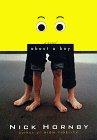
I TRIED TO READ FICTION. I tried, but couldn't do it! A fan of the movie and after so many rave reviews of the book from people I hold in high regard, I tried to read it. Got halfway through it before I couldn't pretend to be interested anymore. Having seen the movie, I know the selfish, sexist prick of a main character eventually comes to have warm fuzzy feelings for humanity, befriends a lonely outcast weird child and his hippie, neurotic mother, and learns that love and friendship and community are all about being yourself.
So why waste my time reading about it? Yeah, Hornby is a good writer. In the half of the book that I read, he manages to capture the unifying isolation of both bachelor life in London and the awkwardness of adolescence. I get it. I get the symbolism of the title as it relates to the positions of the characters of different ages. I understand how the individual and individual relationships are often lost in the anonymity and conformity of postmodern urban life.
But fiction is still an underappreciated realm for me. I understand the beauty of language, and how an author can create characters and scenarios that make larger statements about life and society and people, or just create pure escapist worlds simply because they don't make larger statements about life and society and people.
Hell, I used to want to write fiction, with my wacked-out, angst-ridden teenage worldview. I also used to read a hell of a lot of it, when there was really nothing else to do in middle and high school. (When you're not allowed to watch TV, everyone from Carolyn Keene to Jane Austen provides appropriate mental escape routes).
Again, though, why read it? Why not just deal with (and fix!) life, society, and people? Why create alternate worlds that can only serve as commentaries, but never offer concrete solutions?
Oddly enough, my two favorite books (In Our Time and The Great Gatsby) are works of fiction! I suspect I like fiction from earlier times because I see them more as historical texts. I can analyze and study them as cultural artifacts.
The historian in me knows that today's fiction will be the artifacts of tomorrow. The sociologist in me can analyze the impact of the commodity and the socioeconomic structures of today's literature. But I can't read it myself. Not now. Not anymore.
Saturday, January 08, 2005
Lifting the lamp beside the golden door
Amid all the tsunami aid coverage, I went to see a local documentary about the "Lost Boys" of Sudan. Very well done film, and the panel afterwards was fairly decent.
One of the people profiled in the movie mentioned that Americans love to hear their story (NBC did some huge special on the "Lost Boys"), but that nobody cares about stopping the civil war in Sudan. Unfortunately, it's true. Because the Lost Boys' stories fit so perfectly into the American myth of rags-to-riches. Audiences soak up the scenes of the third world kids staring in wonder at a telephone, a milk carton, a shopping mall. These images reinforce notions of national superiority by underscoring the terrible conditions of an underdeveloped country, conditions that drove them from the longest-running civil war in modern history. The Lost Boys' mass exodus evokes overtly biblical imagery: wandering the wilderness from Ethiopia to Kenya until finally coming to the promised land of tennis shoes, education, fast food.
Of course Americans don't care about the war. (How many even know that a peace deal was even reached?) The war was about, in part, access to the oil fields in southern Sudan. The Muslim/Christian and Arab/black differences that are thrown in are all too familiar, though equally as epic. Interest in the stories from Sudan are more about the American ego, of reassurance that the "wretched refuse" and "homeless, tempest-tossed" from others' teeming shores can only find peace in the U.S. The stories speak to historic feelings involving third world/first world, black/nonblack, and dominant culture/immigrant dynamics.
Americans continue to be mentally isolationist, while believing themselves to be wonderfully enlightened and international.
Subscribe to:
Posts (Atom)