I'm still fascinated by the huge range of children's author Sharon Creech. Half of her books are brilliant, timeless snapshots of the complicated family and social dynamics that children learn to navigate. And the other half are disappointments.
Heartbeat was in the vein of two of her other brilliant poetry books (Love That Dog and Hate That Cat), and it's also told in verse. A tween girl who loves running has a school assignment to draw the same apple every day. The metaphor is beautiful: as her best friend becomes moody and obsessed with winning races and her mother gives birth to a new sibling and her grandfather, the girl The world changes but remains the same and regenerates and regrows and is reborn. Loved this short book.
Ruby Holler, however, was similar to The Castle Corona and The Unfinished Angel in that it projected a pseudo-fairy tale quality in an over-stylized setting. Two orphans ("trouble twins") are adopted for a summer by an older couple who want to take separate trips but not alone. Like most of Creech's books, it too had an intergenerational aspect to it, but it was over-simplified for me to find compelling and interesting. It could have been deeper: the parallel aspects of the twins' inseparable nature and the old couple's shared life could have been a richer part of the story. But instead, the antics of a bumbling, corrupt orphanage director were developed at the cost of the better story - that of the adolescents and retirees finding common ground and building trust.
Of course, I'm still going to read all of Sharon Creech's books! The four that I've absolutely loved and think are beautiful pieces of poetry far outweigh the impact of the ones that seem half-assed in their portraits of human interactions.
"[w]hat was any art but ... a sheath, a mould in which to imprison for a moment the shining, elusive element which is life itself - life hurrying past us and running away, too strong to stop, too sweet to lose." - Willa Cather, Song of the Lark
Saturday, October 06, 2012
Saturday, September 29, 2012
Little grey cells, mon ami
It's getting harder and harder to find mystery series set between the World Wars with female detectives. But I found another, and it's entertaining: Carola Dunn's Daisy Dalrymple series.
(Funny thing, back in my middle school Regency Romance phase, I remember reading books by Carola Dunn. After a bit of research, I learned she's crossed genres.)
The Daisy books are yet another take on the privileged-girl-tries-to-make-her-own-way-in-the-world tale. The heroine, the Honourable Daisy Dalrymple, is a writer for a magazine, and uses her society connections to write articles on stately homes and gardens around England.
They were definitely enjoyable enough, in a Christie-like way. And like any post-WW1 story, the cultural shift in women's roles and the slow disintegration of class lines are central to the story. (One does not, for instance, pursue a Scotland Yard inspector if one is an Honourable. One does not work.)
Unlike the Maisie Dobbs mystery series, which is wonderful but a bit heavy in its post-war legacy and class identity themes, the Daisy books seem to follow the Dame's successful formula: manor, small social circle of suspects (most of them fairly privileged), clever but not cliffhanging resolution.
More on order from the library!
(Funny thing, back in my middle school Regency Romance phase, I remember reading books by Carola Dunn. After a bit of research, I learned she's crossed genres.)
The Daisy books are yet another take on the privileged-girl-tries-to-make-her-own-way-in-the-world tale. The heroine, the Honourable Daisy Dalrymple, is a writer for a magazine, and uses her society connections to write articles on stately homes and gardens around England.
They were definitely enjoyable enough, in a Christie-like way. And like any post-WW1 story, the cultural shift in women's roles and the slow disintegration of class lines are central to the story. (One does not, for instance, pursue a Scotland Yard inspector if one is an Honourable. One does not work.)
Unlike the Maisie Dobbs mystery series, which is wonderful but a bit heavy in its post-war legacy and class identity themes, the Daisy books seem to follow the Dame's successful formula: manor, small social circle of suspects (most of them fairly privileged), clever but not cliffhanging resolution.
More on order from the library!
Tuesday, September 11, 2012
The world breaks everyone
The bleak outlook of Train Dreams reminded me of Swamplandia!, minus the quirky characters and humor.
The story of a dying era in a dying landscape, Train Dreams follows one man from his days logging in the Cascades to his seasonal hermitages in Idaho, Montana, and Canada. From one isolated cabin or church or town to the next, trains rush through desolate regions ghost-filled with broken lives and loss.
Even though it is equally as devoid of hope and happiness as the last book I read.... at least it's in my own neck of the woods?
The story of a dying era in a dying landscape, Train Dreams follows one man from his days logging in the Cascades to his seasonal hermitages in Idaho, Montana, and Canada. From one isolated cabin or church or town to the next, trains rush through desolate regions ghost-filled with broken lives and loss.
Even though it is equally as devoid of hope and happiness as the last book I read.... at least it's in my own neck of the woods?
Monday, September 10, 2012
Hell is empty; all the devils are here
I wanted to like Swamplandia! but I couldn't really get into it. It took me try after try to get into it, and I never really succeeded; I only finished it because I wanted to make the overdue fines worthwhile...
A depressing tale about a family business (and a family itself, local culture, and way of life) crumbling in the Everglades, the book is certainly well-written and evocative. The main character is Ava, a tween girl whose family all leave: her mother dies of cancer, her father heads to the mainland to work at a strip club to pay off debts, her brother goes to work for the family's corporate rivals, and her mentally unstable sister runs away to marry a long-dead (and possibly made-up) teenage boatman. It has delightfully quirky elements and enough interesting dynamics -- like alligator-wrestling, a tragic ghost story, or glimpses of irony and comedy in characters' seemingly ordinary lives.
But there were a few needlessly shocking parts (I fail to see how statutory rape, for instance, was in any way symbolic or relevant). And throughout the book, the themes of abandonment and failure were made brutally clear: failed government revitalization programs, inadequate education, islands cut off from the mainland, changing muddy coastlines, derelict boats, etc. The past, present, and future presented in the book are rather abysmal and hopeless. By the end of the book, instead of celebrating the intricate and highly complicated histories of Ava's swamp heritage, I was horrified and simply glad that the book ended with her making it out of a mental and physical hellhole.
That sense of relief, if not the overall story itself, was worth the $1.60 fine.
A depressing tale about a family business (and a family itself, local culture, and way of life) crumbling in the Everglades, the book is certainly well-written and evocative. The main character is Ava, a tween girl whose family all leave: her mother dies of cancer, her father heads to the mainland to work at a strip club to pay off debts, her brother goes to work for the family's corporate rivals, and her mentally unstable sister runs away to marry a long-dead (and possibly made-up) teenage boatman. It has delightfully quirky elements and enough interesting dynamics -- like alligator-wrestling, a tragic ghost story, or glimpses of irony and comedy in characters' seemingly ordinary lives.
But there were a few needlessly shocking parts (I fail to see how statutory rape, for instance, was in any way symbolic or relevant). And throughout the book, the themes of abandonment and failure were made brutally clear: failed government revitalization programs, inadequate education, islands cut off from the mainland, changing muddy coastlines, derelict boats, etc. The past, present, and future presented in the book are rather abysmal and hopeless. By the end of the book, instead of celebrating the intricate and highly complicated histories of Ava's swamp heritage, I was horrified and simply glad that the book ended with her making it out of a mental and physical hellhole.
That sense of relief, if not the overall story itself, was worth the $1.60 fine.
Sunday, August 26, 2012
Mountain mama
Northwesterners call Mt. Rainier "The Mountain". At 14,410 feet, it's the tallest mountain in Washington State and the entire Cascade range.
When The Mountain is "out", as Northwesterners also say on clear sunny days when it's visible, this is what it looks like from my neighborhood in Seattle (photo credit: a University of Washington site):
4600 feet in elevation gain is the most I've ever hiked.
Personal records FTW!
Then we glissaded down the snowfield. So amazingly fun!
Rainier is a regional icon (it's on the state's license plate). It's also a dormant stratovolcano, considered one of the most dangerous in the world.
But it's such a beautiful and awe-inspiring volcano!This is what it looks like from one of the trails near the Mount Rainier National Park Visitors Center:
I love, love, love mountain meadows! The wildflowers are so amazing.This is what it looks like when you get a little further from the tourist center:
(There was a mama deer! With her two fawns! How much more picturesque could it get? Photo credits for the rest of this post: me)
It's still a hefty hike, even on the paved pathways.
I finally saw a marmot in the wild!This is what The Mountain looks like when you reach Muir Snowfield:
(Do NOT google anything like "deaths Rainier Muir snowfield" in the days before you set out to hike it. Otherwise you might be tempted to run out and buy a ton of emergency equipment at REI. *cough* )This is how steep the slope is:
Muir Snowfield is 2.2 miles long and has an elevation gain of 2800 feet.
It was brutal. I was worried about altitude and dehydration, so I stopped often. (Also, I huffed and puffed nonstop.)
But the view was amazing!
The Tatoosh Mountains, which I've only ever seen in winter, were beautiful. Beyond them, both Mt. Adams and Mt. St. Helens were visible - it's as if three tall mountains in the Cascade range get to say "Hello!" to each other every sunny day.And this is what Mt. Rainier looks like at the almost-top!
10,188 feet is the highest I've ever been (not counting airplanes, obviously).We made it to Camp Muir! I'm so proud of myself and my two friends - we weren't sure if we could make it, but we did!
4600 feet in elevation gain is the most I've ever hiked.
Personal records FTW!
Then we glissaded down the snowfield. So amazingly fun!
Tuesday, August 21, 2012
Daring an opposite to every danger
The first book in the Graceling trilogy was mostly captivating but really slow towards the end (the characters wander in the mountains for months). The second book, Fire, was the opposite: it took me a while to get into it (more wandering across rugged terrain), but the last half had court intrigues that made slogging through the first half worth it. Bitterblue, the last book, ties together the stories from the first two. But even better, it didn't bore me for any part.
Though each book can stand alone and the reader doesn't need to read them together or in order, they do fit together nicely. Fire is the prequel to Graceling, taking place decades before in a faraway kingdom where beautifully-hued "monsters" mesmerize their victims. Bitterblue picks up 9 years after Graceling, when a child queen comes of age and faces the difficult task of healing a kingdom scarred by her sadistic, psychopathic father's reign of cruelty.
One cool theme throughout the trilogy (besides strong-willed young female protagonists) was the idea that women can defend themselves and that happily-ever-after romances are the stuff of unrealistic fairy tales. In these books, the heroines don't want marriage or a traditional gendered relationship, and they are jarringly realistic about sex and love and time. Nothing wraps up neatly, whether it's the fate of a local uprising or the future of a budding friendship.
Bitterblue left me wanting more stories from this intricate, nuanced world. But alas! As a trilogy, though, it was epically satisfying.
Though each book can stand alone and the reader doesn't need to read them together or in order, they do fit together nicely. Fire is the prequel to Graceling, taking place decades before in a faraway kingdom where beautifully-hued "monsters" mesmerize their victims. Bitterblue picks up 9 years after Graceling, when a child queen comes of age and faces the difficult task of healing a kingdom scarred by her sadistic, psychopathic father's reign of cruelty.
One cool theme throughout the trilogy (besides strong-willed young female protagonists) was the idea that women can defend themselves and that happily-ever-after romances are the stuff of unrealistic fairy tales. In these books, the heroines don't want marriage or a traditional gendered relationship, and they are jarringly realistic about sex and love and time. Nothing wraps up neatly, whether it's the fate of a local uprising or the future of a budding friendship.
Bitterblue left me wanting more stories from this intricate, nuanced world. But alas! As a trilogy, though, it was epically satisfying.
All the difference
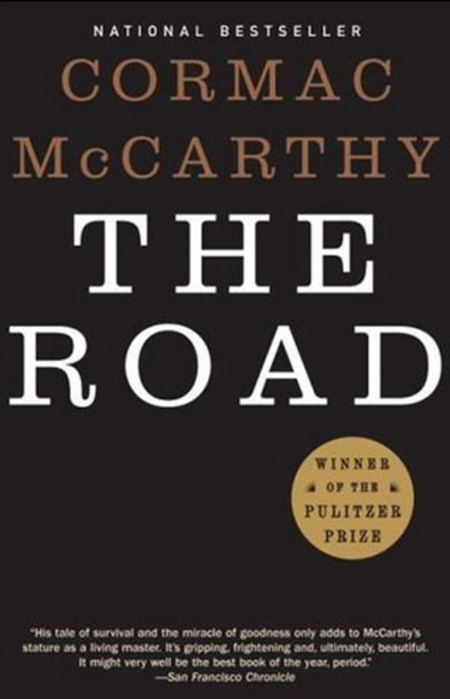
The Road was one of the most bleak and depressing books I've read in a very long time.
A nameless father and a nameless son journey across a post-apocalyptic America after an unnamed catastrophe that has wiped out most life on earth. They trudge through ashes of a burned-out world, scrounging for non-perishable food items hidden in ghost towns, running away from cannibals, stepping over long-mummified bodies of fellow citizens along the way.
Amid the despair, their love for each other and their barely-alive hope that they will encounter other "good guys" are manifest in evolving but timeless ways.
Still, it's an incredibly gloomy portrait of how kindness survives. Half of the hopelessness and helplessness comes from not knowing what the characters don't know themselves: the how and the why of what happened to the world.
McCarthy's writing style mimics the barren wasteland he has created: there are no quotation marks, few proper nouns, few apostrophes. Sentences and dialogues are short.
I might need to go watch The Care Bears for a while. But in the meantime, this poem that I've always liked by Walter d la Mare might serve as a good transition from McCarthy's despairingly desolate scenes:
OK, time for Care Bears.
A nameless father and a nameless son journey across a post-apocalyptic America after an unnamed catastrophe that has wiped out most life on earth. They trudge through ashes of a burned-out world, scrounging for non-perishable food items hidden in ghost towns, running away from cannibals, stepping over long-mummified bodies of fellow citizens along the way.
Amid the despair, their love for each other and their barely-alive hope that they will encounter other "good guys" are manifest in evolving but timeless ways.
Still, it's an incredibly gloomy portrait of how kindness survives. Half of the hopelessness and helplessness comes from not knowing what the characters don't know themselves: the how and the why of what happened to the world.
McCarthy's writing style mimics the barren wasteland he has created: there are no quotation marks, few proper nouns, few apostrophes. Sentences and dialogues are short.
I might need to go watch The Care Bears for a while. But in the meantime, this poem that I've always liked by Walter d la Mare might serve as a good transition from McCarthy's despairingly desolate scenes:
The Listeners
Walter de la Mare
The silence surging softly backward has always been a particularly poignant image.
'Is there anybody there?' said the Traveller,Knocking on the moonlit door;And his horse in the silence champ'd the grassesOf the forest's ferny floor:And a bird flew up out of the turret,Above the Traveller's head:And he smote upon the door again a second time;'Is there anybody there?' he said.But no one descended to the Traveller;No head from the leaf-fringed sillLean'd over and look'd into his grey eyes,Where he stood perplex'd and still.But only a host of phantom listenersThat dwelt in the lone house thenStood listening in the quiet of the moonlightTo that voice from the world of men:Stood thronging the faint moonbeams on the dark stair,That goes down to the empty hall,Hearkening in an air stirr'd and shakenBy the lonely Traveller's call.And he felt in his heart their strangeness,Their stillness answering his cry,While his horse moved, cropping the dark turf,'Neath the starr'd and leafy sky;For he suddenly smote on the door, evenLouder, and lifted his head:--'Tell them I came, and no one answer'd,That I kept my word,' he said.Never the least stir made the listeners,Though every word he spakeFell echoing through the shadowiness of the still houseFrom the one man left awake:Ay, they heard his foot upon the stirrup,And the sound of iron on stone,And how the silence surged softly backward,When the plunging hoofs were gone.
OK, time for Care Bears.
Saturday, August 04, 2012
Nonna, nonna
As I'm making my way through the books of children's author Sharon Creech, I'm finding that they're hit or miss with me.
While I absolutely LOVED Walk Two Moons and Love That Dog / Hate That Cat and thought they were near genius, I didn't exactly love The Castle Corona. It's a quasi-fairy tale story about two peasant siblings and three royal siblings. It was pretty predictable and lacked the depth that some of Creech's other books model.
Granny Torrelli Makes Soup was better. It was definitely a cute story, about two friends who grow up next door to each other but then as adolescence hits and new neighbors arrive, they find themselves floating apart. It was predictable and unresolved in that way that young adult books sometimes are ("It'll all be OK. Things change, but your family loves you.").
Both books were really short, good for zippy summer night reading.
While I absolutely LOVED Walk Two Moons and Love That Dog / Hate That Cat and thought they were near genius, I didn't exactly love The Castle Corona. It's a quasi-fairy tale story about two peasant siblings and three royal siblings. It was pretty predictable and lacked the depth that some of Creech's other books model.
Granny Torrelli Makes Soup was better. It was definitely a cute story, about two friends who grow up next door to each other but then as adolescence hits and new neighbors arrive, they find themselves floating apart. It was predictable and unresolved in that way that young adult books sometimes are ("It'll all be OK. Things change, but your family loves you.").
Both books were really short, good for zippy summer night reading.
Thursday, August 02, 2012
Vissi d'arte, vissi d'amore
I don't remember how Bel Canto came to my attention, but I'm incredibly glad it made its way onto my reading list. Like the opera masterpieces that frame the characters and the storyline, the book is an exquisite work of art, beautifully and skillfully written.
The tale unfolds at a dinner party with an array of important individuals: a famous opera singer, politicians, priests, ambassadors, businessmen from all over the world ... and the terrorist generals and child soldiers that intrude and hold them all hostage.
Amid the chaos and power struggles, Patchett's narration floats like an aria from person to person, past to future. The book is a fascinating and lyrical portrait of human behavior in all its uncomplicated intricacies. Friendships, romantic relationships, and transactional alliances are all played out on a grand scale. (In real life, the reader knows these scenarios are highly unlikely. But this is an opera. It's comedy, tragedy, love, hate, and pathos blended into one.)
Though the ending was hinted at throughout the book, the epilogue seemed completely out of place. The role of nostalgia in survival is important, but the last few pages only make sense on a metaphorical level rather than a tangible human one.
Still, Bel Canto was categorically, utterly amazing.
The tale unfolds at a dinner party with an array of important individuals: a famous opera singer, politicians, priests, ambassadors, businessmen from all over the world ... and the terrorist generals and child soldiers that intrude and hold them all hostage.
Amid the chaos and power struggles, Patchett's narration floats like an aria from person to person, past to future. The book is a fascinating and lyrical portrait of human behavior in all its uncomplicated intricacies. Friendships, romantic relationships, and transactional alliances are all played out on a grand scale. (In real life, the reader knows these scenarios are highly unlikely. But this is an opera. It's comedy, tragedy, love, hate, and pathos blended into one.)
Though the ending was hinted at throughout the book, the epilogue seemed completely out of place. The role of nostalgia in survival is important, but the last few pages only make sense on a metaphorical level rather than a tangible human one.
Still, Bel Canto was categorically, utterly amazing.
Saturday, July 07, 2012
Unacknowledged legislators of the world
Because library books on reserve tend to arrive all at once in a great cosmic plot to make me have more overdue fines, I was able to read two more of Sharon Creech's charming (and short) stories.
Love That Dog and its sequel Hate That Cat were cute and inspiring. Each book takes about 20 minute to read, so it was perfect for a weekend camping trip with limited daylight hours.
The books, through poetry writing assignments, tell the story of Jack, a kid who at first hates writing poetry. But as his teacher Miss Stretchberry continually challenges him to re-think what he considers poetry, he gradually learns to love it.
In Dog, Jack slowly comes out of his shell and eventually shares a personal painful story of his. It's the classic story of a boy and his dog, told through poetry influenced by William Carlos Williams, Robert Frost, Valerie Worth, and others. In Cat, the reader learns more about Jack's family, and through his evolving relationship with poetry and words he is able to understand how sights and sounds can be felt.
Like the Creech's other books I've read, I'm amazed by how aptly she has captured the fresh and innocent voice of a child struggling to understand life and death while still enjoying play time and simple daily comforts.
The books are also a wonderful tribute to teachers everywhere who encourage students to find their voices and share their stories. I couldn't stop smiling, watching Jack learn and grow throughout the books. Perfect quick summer reads!
Love That Dog and its sequel Hate That Cat were cute and inspiring. Each book takes about 20 minute to read, so it was perfect for a weekend camping trip with limited daylight hours.
The books, through poetry writing assignments, tell the story of Jack, a kid who at first hates writing poetry. But as his teacher Miss Stretchberry continually challenges him to re-think what he considers poetry, he gradually learns to love it.
In Dog, Jack slowly comes out of his shell and eventually shares a personal painful story of his. It's the classic story of a boy and his dog, told through poetry influenced by William Carlos Williams, Robert Frost, Valerie Worth, and others. In Cat, the reader learns more about Jack's family, and through his evolving relationship with poetry and words he is able to understand how sights and sounds can be felt.
Like the Creech's other books I've read, I'm amazed by how aptly she has captured the fresh and innocent voice of a child struggling to understand life and death while still enjoying play time and simple daily comforts.
The books are also a wonderful tribute to teachers everywhere who encourage students to find their voices and share their stories. I couldn't stop smiling, watching Jack learn and grow throughout the books. Perfect quick summer reads!
Thursday, July 05, 2012
Oft in ourselves do lie
From books to movies, I seem to be on a young adult audience kick. In this stressful election year, however, I think that's totally justifiable. What better escapism is there than to re-live the agony of adolescence, now that I'm safely and long past it?
I'm not the biggest fan of Wes Anderson's style of comedy (it's a little too deadpan for me), though I loved The Royal Tenenbaums. There were many moments in Moonrise Kingdom, however, where I genuinely laughed out loud or found a particular scene profoundly striking in its imagery.
Two New England tweens run away from their dismal lives and try to forge a new happy and free existence of their own making. Adults and a boy scout troop pursue them. So does a hurricane. Moonrise Kingdom was quirky and old-school epic, but cute nonetheless.
And then there was Brave. Honestly, the only thing I knew about it (enough to get me to a theatre) was that it had a feisty young heroine and took place in ancient Scotland.
SCOTLAND!!!!
I think I was expecting something along the lines of Mulan-meets-Braveheart. But what it turned out to be was a pretty sweet tale of mothers and daughters and courage and acceptance. There's the prerequisite Celtic witch, and a spell, and bears.
BEARS!!!!
I really, really liked it (SCOTLAND! BEARS!) but wasn't over-the-top wowed by it. It was also the first movie I've ever seen in 3-D, although I don't know that it made any real difference for this film.
But while I was hiking in Central Washington this past weekend, I couldn't stop thinking in a Scottish accent.
Wha's like us? Damn few...
I'm not the biggest fan of Wes Anderson's style of comedy (it's a little too deadpan for me), though I loved The Royal Tenenbaums. There were many moments in Moonrise Kingdom, however, where I genuinely laughed out loud or found a particular scene profoundly striking in its imagery.Two New England tweens run away from their dismal lives and try to forge a new happy and free existence of their own making. Adults and a boy scout troop pursue them. So does a hurricane. Moonrise Kingdom was quirky and old-school epic, but cute nonetheless.
And then there was Brave. Honestly, the only thing I knew about it (enough to get me to a theatre) was that it had a feisty young heroine and took place in ancient Scotland.
SCOTLAND!!!!
I think I was expecting something along the lines of Mulan-meets-Braveheart. But what it turned out to be was a pretty sweet tale of mothers and daughters and courage and acceptance. There's the prerequisite Celtic witch, and a spell, and bears.
BEARS!!!!
I really, really liked it (SCOTLAND! BEARS!) but wasn't over-the-top wowed by it. It was also the first movie I've ever seen in 3-D, although I don't know that it made any real difference for this film.
But while I was hiking in Central Washington this past weekend, I couldn't stop thinking in a Scottish accent.
Wha's like us? Damn few...
Wednesday, July 04, 2012
Into the vale of years
Because I really liked Sharon Creech's Replay, I reserved a few of her other books at the library. One of the things I liked about Replay was Creech's ability to capture the voice, demeanor, and language of an adolescent so well.
The Unfinished Angel was similarly intriguing in its linguistic voice: the main character is an angel who guards a tiny village in Italy, and who struggles with speaking and understanding human ways of communication. That was the most interesting part of the short book, however; I wasn't as captivated by the plot itself, about a little girl who can see the angel and convinces it to help change things for children nearby.
Walk Two Moons, however, was simply a masterpiece. It's no wonder that it won the Newbery Medal. The storytelling mechanism was brilliant: a girl on a road trip with her grandparents helps pass the time by telling them stories of her best friend's weird family. The stories are true, but the grandparents know they're just a metaphor for the girl's own growing pains and unique family heartache.
Even though, from an adult perspective, the ending isn't a surprise at all (it was pretty easy to read between the lines), I still found myself crying as I read the last few chapters. It was such a beautiful, sweet, tragic tale of love and hope and family ties.
As young adult authors go, I like Sharon Creech because her writing style also appeals to adults. The plots of her books (at least three I've read so far) take place at the very real intergenerational crossroads of family life.
The Unfinished Angel was similarly intriguing in its linguistic voice: the main character is an angel who guards a tiny village in Italy, and who struggles with speaking and understanding human ways of communication. That was the most interesting part of the short book, however; I wasn't as captivated by the plot itself, about a little girl who can see the angel and convinces it to help change things for children nearby.
Walk Two Moons, however, was simply a masterpiece. It's no wonder that it won the Newbery Medal. The storytelling mechanism was brilliant: a girl on a road trip with her grandparents helps pass the time by telling them stories of her best friend's weird family. The stories are true, but the grandparents know they're just a metaphor for the girl's own growing pains and unique family heartache.Even though, from an adult perspective, the ending isn't a surprise at all (it was pretty easy to read between the lines), I still found myself crying as I read the last few chapters. It was such a beautiful, sweet, tragic tale of love and hope and family ties.
As young adult authors go, I like Sharon Creech because her writing style also appeals to adults. The plots of her books (at least three I've read so far) take place at the very real intergenerational crossroads of family life.
Monday, June 25, 2012
Not in our stars, but in ourselves
I am currently $0.25 away from having my library card shut down again, in part due to two books I read, appreciated but didn't love, and then promptly forgot to return.
The Imperfectionists was a collection of sad stories about the staff of a declining English-language newspaper headquartered in Rome. They were all interesting and well-written, even if the the stories themselves a bit depressing. Each glimpse into the lives of the editors, reporters, and owners of the newspaper highlighted the not-so-newsworthy human dramas of deception, pain, lust, fear, disappointment, and anger. Something ended, for better or worse, in every vignette -- all against the backdrop of the methodic production of a daily paper whose identity and existence are become irrelevant in an internet age.
I'm not the biggest proponent of saving newspapers for their own sake; I think the smell of ink on a printing press and the illusion of objective "truth" have been overly romanticized. I'm more concerned that the decline of newspapers means fewer voices in media, not that everyone will suddenly be unconcerned with what is going on in the world because there are fewer stacks of papers in it. I think there's a way to honor the legacy of the print room without making it a funeral for journalism itself, which has always adapted to technology.
After all, the empire fell, but Rome is still a vibrant city.
By contrast, Vaclav and Lena was a sweet and bittersweet tale about two Russian kids who meet in ESL class, become friends, plan a future as magicians, and then are abruptly separated for seven years by a mysterious event.
As an immigrant tale, the lives of Vaclav and Lena are bookends: one speaks Russian at home, one has parents who want to speak only English. Both have families that work incredibly hard, long hours in very different industries and with very different risks. Hunger and food, disadvantage and opportunity, acceptance and hope, American Dream and fairy tale: the story of two children and their circumstances is both uncomfortably familiar and refreshingly new.
Though the overall tone of the book is not exactly happy (in fact, it took me a while to plug through because it was kind of depressing), I thought it was cute and beautifully written.
And my new goal for this summer is to return the rest of my library books on time.
The Imperfectionists was a collection of sad stories about the staff of a declining English-language newspaper headquartered in Rome. They were all interesting and well-written, even if the the stories themselves a bit depressing. Each glimpse into the lives of the editors, reporters, and owners of the newspaper highlighted the not-so-newsworthy human dramas of deception, pain, lust, fear, disappointment, and anger. Something ended, for better or worse, in every vignette -- all against the backdrop of the methodic production of a daily paper whose identity and existence are become irrelevant in an internet age.I'm not the biggest proponent of saving newspapers for their own sake; I think the smell of ink on a printing press and the illusion of objective "truth" have been overly romanticized. I'm more concerned that the decline of newspapers means fewer voices in media, not that everyone will suddenly be unconcerned with what is going on in the world because there are fewer stacks of papers in it. I think there's a way to honor the legacy of the print room without making it a funeral for journalism itself, which has always adapted to technology.
After all, the empire fell, but Rome is still a vibrant city.
By contrast, Vaclav and Lena was a sweet and bittersweet tale about two Russian kids who meet in ESL class, become friends, plan a future as magicians, and then are abruptly separated for seven years by a mysterious event.As an immigrant tale, the lives of Vaclav and Lena are bookends: one speaks Russian at home, one has parents who want to speak only English. Both have families that work incredibly hard, long hours in very different industries and with very different risks. Hunger and food, disadvantage and opportunity, acceptance and hope, American Dream and fairy tale: the story of two children and their circumstances is both uncomfortably familiar and refreshingly new.
Though the overall tone of the book is not exactly happy (in fact, it took me a while to plug through because it was kind of depressing), I thought it was cute and beautifully written.
And my new goal for this summer is to return the rest of my library books on time.
Sunday, June 10, 2012
Alter or mend eternal Fact
I was excited to see that the latest books in two fun mystery series just came out! (And once I paid my library fines, I could borrow them from the library.)
Elegy for Eddie is the latest in the Maisie Dobbs series. The series started out as a Great War survivors' tale, and this most recent book takes place in 1933. We all know what that means. Our psychologist investigator, as always, is caught between the vanishing world of London's South End and Britain's political and social elite. Between helping costermongers uncover the truth behind the death of one of their own, driving her trendy automobile around the horses in her old urban neighborhood, and trying to branch out and see the world before it devolves into another World War, Maisie's character is finally unraveling. It only took 9 books that chart her life over 19 years, but she's finally become a more nuanced and conflicted character than she's been in the previous books. The added painful irony of her finally finding her own personal freedom and peace is that it comes on the eve of another horrible world tragedy equally as traumatic as the one that first drove her into a stodgy, silent shell. It's not hard to deduce that there are several overlapping elegies running throughout the course of the mystery.
The other mystery-solving heroine I love is Molly Murphy. In the latest book in her series, she and her police captain are finally married and spending their honeymoon in a haunted mansion in Newport. Like Maisie, Molly is also caught between her humble, poverty-stricken background and the powerful world of Tammany Hall that she has been thrown into.
Maybe I'm drawn to these two characters (and a few other in certain series) because of those contrasts in background and circumstances. The tale of an honest class identity struggle can frequently walk a fine line with the overdone and untrue rags-to-riches tale; but maybe the internal existential battles that must necessarily be waged are the unacknowledged flip side of the latter.
Speaking of which, I'm excited to see the new The Great Gatsby movie coming out later this year.
And now I have "Too Ra Loo Ra Loo Ral" stuck in my head.
Elegy for Eddie is the latest in the Maisie Dobbs series. The series started out as a Great War survivors' tale, and this most recent book takes place in 1933. We all know what that means. Our psychologist investigator, as always, is caught between the vanishing world of London's South End and Britain's political and social elite. Between helping costermongers uncover the truth behind the death of one of their own, driving her trendy automobile around the horses in her old urban neighborhood, and trying to branch out and see the world before it devolves into another World War, Maisie's character is finally unraveling. It only took 9 books that chart her life over 19 years, but she's finally become a more nuanced and conflicted character than she's been in the previous books. The added painful irony of her finally finding her own personal freedom and peace is that it comes on the eve of another horrible world tragedy equally as traumatic as the one that first drove her into a stodgy, silent shell. It's not hard to deduce that there are several overlapping elegies running throughout the course of the mystery.The other mystery-solving heroine I love is Molly Murphy. In the latest book in her series, she and her police captain are finally married and spending their honeymoon in a haunted mansion in Newport. Like Maisie, Molly is also caught between her humble, poverty-stricken background and the powerful world of Tammany Hall that she has been thrown into.
Maybe I'm drawn to these two characters (and a few other in certain series) because of those contrasts in background and circumstances. The tale of an honest class identity struggle can frequently walk a fine line with the overdone and untrue rags-to-riches tale; but maybe the internal existential battles that must necessarily be waged are the unacknowledged flip side of the latter.
Speaking of which, I'm excited to see the new The Great Gatsby movie coming out later this year.
And now I have "Too Ra Loo Ra Loo Ral" stuck in my head.
Friday, June 08, 2012
Zing! Pow! Bang!
Every now and then, I go on a "cheesy fun" movie-watching splurge. Since I cancelled my subscription to Netflix, I've been going to the theatre more. (I've also been reading more, but that's a separate issue. Or is it?)
I'm a fan of Sacha Baron Cohen and his particularly bold style of exposing people's stereotypes and prejudices, so a friend and I saw The Dictator. (But first we each downed a small bottle of sake -- arguing with a random lady at the cineplex bar about the social value of Cohen's films -- and then raced into the theatre).
Alternet had a really good review of the movie, comparing it to Charlie Chaplin's satire about a Hitler-like leader in The Great Dictator.
I can't say The Dictator is my favorite Cohen project, but I still liked it well enough. Cohen plays Aladeen (yes, start singing "A Whole New World"), dictator of the fictitious Arab country of Wadiya, who is replaced by a lookalike while in New York City and tries to get his identity back. In the process, he meets refugee Wadiyans, hippie food co-op liberal do-gooders, and pro-democracy protestors. The plot is predictable, but the plot isn't really the point of the movie. The point of the movie is summarized by Aladeen's ironic speech near the end:
Because every good holiday involves a blockbuster, I also saw The Avengers. It was good cheesy fun, even though the only Avenger back-story I've watched is Captain America. You don't really need to know the histories of each of the Marvel comic characters to get the point: Earth is threatened, and a supersecret government agency rounds up six superheroes (The Incredible Hulk, Captain America, Iron Man, Thor, Hawkeye, and the Black Widow) to save it. I thought the dialogue between Captain American and Iron Man was hilarious, as was the way all the superheroes were making fun of Captain America (he was frozen for 50 years and doesn't understand a lot of modern references). Clark Gregg was great as a the serious government agent who is a giddy fan of Captain America: he embodies the audience, comic book geeks or not, who came to see a movie about superheroes because, deep down, we all like a good, clean-cut story where "obvious" good triumphs over "obvious" evil. So much simpler than all these real-life gray areas!
Continuing the "good cheesy fun" theme wasn't difficult, since Men In Black 3 was also in theatres. And this one involves time travel! (Time travel, of course, is my sci-fi weakness.)
I'm a huge fan of Tommy Lee Jones, and in MIB3 Josh Brolin does a really good job of imitating Jones' Agent K when Will Smith goes back in time to the moon landing to save not just the Earth but his future partner.
The only not-so-cool section was near the beginning, where an entire Chinese restaurant filled with exotic, funny-looking food and funny-talking and -looking people turns out to be a cover for illegal extraterrestrial activity. When I vented to Mi Hermana after watching the movie, she reminded me that the first MIB movie had aliens disguised as Mexicans crossing the border... so I think "immigrants" and "weird aliens" are too closely linked in the MIB trilogy for my comfort.
But aside from that, they're fun to watch. And with primary election endorsements stressing me out for the entire month of May, I needed a lot of good cheesy fun to detox!
I'm a fan of Sacha Baron Cohen and his particularly bold style of exposing people's stereotypes and prejudices, so a friend and I saw The Dictator. (But first we each downed a small bottle of sake -- arguing with a random lady at the cineplex bar about the social value of Cohen's films -- and then raced into the theatre).Alternet had a really good review of the movie, comparing it to Charlie Chaplin's satire about a Hitler-like leader in The Great Dictator.
I can't say The Dictator is my favorite Cohen project, but I still liked it well enough. Cohen plays Aladeen (yes, start singing "A Whole New World"), dictator of the fictitious Arab country of Wadiya, who is replaced by a lookalike while in New York City and tries to get his identity back. In the process, he meets refugee Wadiyans, hippie food co-op liberal do-gooders, and pro-democracy protestors. The plot is predictable, but the plot isn't really the point of the movie. The point of the movie is summarized by Aladeen's ironic speech near the end:
"Imagine a country where 1 percent of the people control most of the wealth and leaders wage war against the wrong country for trumped-up reasons...Imagine a country whose prisons are filled with one racial group."The reason I like Cohen's movies is because he manages to catch people unawares and highlight their own biases and blindnesses. In this case, it's the audience: we thought we were laughing at the absurdities of stereotypes of others (the Arab dictator and white liberal co-op owner really are over-the-top caricatures). But unlike with Borat or Bruno, this time the joke's on the viewer.
Because every good holiday involves a blockbuster, I also saw The Avengers. It was good cheesy fun, even though the only Avenger back-story I've watched is Captain America. You don't really need to know the histories of each of the Marvel comic characters to get the point: Earth is threatened, and a supersecret government agency rounds up six superheroes (The Incredible Hulk, Captain America, Iron Man, Thor, Hawkeye, and the Black Widow) to save it. I thought the dialogue between Captain American and Iron Man was hilarious, as was the way all the superheroes were making fun of Captain America (he was frozen for 50 years and doesn't understand a lot of modern references). Clark Gregg was great as a the serious government agent who is a giddy fan of Captain America: he embodies the audience, comic book geeks or not, who came to see a movie about superheroes because, deep down, we all like a good, clean-cut story where "obvious" good triumphs over "obvious" evil. So much simpler than all these real-life gray areas!Continuing the "good cheesy fun" theme wasn't difficult, since Men In Black 3 was also in theatres. And this one involves time travel! (Time travel, of course, is my sci-fi weakness.)
I'm a huge fan of Tommy Lee Jones, and in MIB3 Josh Brolin does a really good job of imitating Jones' Agent K when Will Smith goes back in time to the moon landing to save not just the Earth but his future partner.
The only not-so-cool section was near the beginning, where an entire Chinese restaurant filled with exotic, funny-looking food and funny-talking and -looking people turns out to be a cover for illegal extraterrestrial activity. When I vented to Mi Hermana after watching the movie, she reminded me that the first MIB movie had aliens disguised as Mexicans crossing the border... so I think "immigrants" and "weird aliens" are too closely linked in the MIB trilogy for my comfort.
But aside from that, they're fun to watch. And with primary election endorsements stressing me out for the entire month of May, I needed a lot of good cheesy fun to detox!
Thursday, May 31, 2012
Each night I ask the stars up above
Because a friend suggested Graceling, I read it. And gobbled it all up in one night. Set in a vaguely medieval world where seven kingdoms have uneasy truces with each other, the book managed to entrance me. Individuals with two differently-colored eyes are "Graced" with an innate gift: the heroine's is killing, which her uncle makes use of by dispatching her as his assassin. But, of course, the oppressed peasants and minor nobles form a secret intelligence network to try and right the wrongs done by the seven not-quite-warring kings.
The plot doesn't seem all that complicated, but it was written so well that it was incredibly spellbinding. Plus, the heroine is honestly a pretty strong-willed person who doesn't change her views for the whims of some romantic fantasy.
It's impossible not to compare it to The Hunger Games: Katsa/Katniss is the teenage heroine, Po/Peeta is the hero, the K girl is skilled at fighting, the P boy is all sensitive and understanding; together they are part of an underground rebellion which the K girl inadvertently leads. Who knows - the chicken or the egg? There are a lot of odd, rather suspicious coincidences.
Then I read the last two books in the Hunger Games trilogy. Like the first, they were captivating enough to keep me reading in one sitting. I loved the twists with a second Hunger Games, an increasingly obvious underground rebellion, and Peeta's capture.
Most of all, I liked how the idea of spectacle, war, and entertainment were intertwined - as Katniss becomes the unwilling symbol of rebellion, she is still "used" and filmed and made up just as she was by the Capitol oppressors who made her fight to the death in the Hunger Games arena.
But after Graceling, Katniss' personal drama was slightly irritating. There was a little too much "boy trouble", as Haymitch put it, and a lot of angry, angsty, reactionary moments. Am I that far removed from being a teenager that I can't relate to the mental confusion of a heartsick, headstrong adolescent?
In the end, I think the Peeta-or-Gale drama detracted from the better, larger story of people standing up for their rights, finding their way in the world, and learning to build community across differences. And I know that the two potential love interests represent different pasts and futures... but it got ridiculously, unnecessarily sappy a lot. Ultimately, the writing relied too much on dialogue and internal monologues rather than on creative and descriptive imagery. (Which is why, despite friends' opinions to the contrary, I still like the Harry Potter series better.)
Oh, and the other thing Graceling had in its favor that the Hunger Games series didn't: it's not written in the first person present tense*!
* one of my pet peeves
The plot doesn't seem all that complicated, but it was written so well that it was incredibly spellbinding. Plus, the heroine is honestly a pretty strong-willed person who doesn't change her views for the whims of some romantic fantasy.
It's impossible not to compare it to The Hunger Games: Katsa/Katniss is the teenage heroine, Po/Peeta is the hero, the K girl is skilled at fighting, the P boy is all sensitive and understanding; together they are part of an underground rebellion which the K girl inadvertently leads. Who knows - the chicken or the egg? There are a lot of odd, rather suspicious coincidences.
Then I read the last two books in the Hunger Games trilogy. Like the first, they were captivating enough to keep me reading in one sitting. I loved the twists with a second Hunger Games, an increasingly obvious underground rebellion, and Peeta's capture.
Most of all, I liked how the idea of spectacle, war, and entertainment were intertwined - as Katniss becomes the unwilling symbol of rebellion, she is still "used" and filmed and made up just as she was by the Capitol oppressors who made her fight to the death in the Hunger Games arena.
But after Graceling, Katniss' personal drama was slightly irritating. There was a little too much "boy trouble", as Haymitch put it, and a lot of angry, angsty, reactionary moments. Am I that far removed from being a teenager that I can't relate to the mental confusion of a heartsick, headstrong adolescent?
In the end, I think the Peeta-or-Gale drama detracted from the better, larger story of people standing up for their rights, finding their way in the world, and learning to build community across differences. And I know that the two potential love interests represent different pasts and futures... but it got ridiculously, unnecessarily sappy a lot. Ultimately, the writing relied too much on dialogue and internal monologues rather than on creative and descriptive imagery. (Which is why, despite friends' opinions to the contrary, I still like the Harry Potter series better.)
Oh, and the other thing Graceling had in its favor that the Hunger Games series didn't: it's not written in the first person present tense*!
* one of my pet peeves
Saturday, May 05, 2012
Merely players
Replay was one of the cutest books I've read in a long time. An 11-year-old with a creative and active imagination -- who is frequently lost in hist large, loud family -- practices for his school play, find his father's journal in the attic, and makes up scenes from his more exciting, fabulous future.
It captured childhood imagination in its purest form, in the most ingenious way: in the context of a child's life, with all the craziness that accompanies family dynamics. Childhood fantasies (like the stage of the school play, like the stage of family drama, like the stage of life) become the arena where confusion, retreat, hopes, and fears are all settled. In the process of becoming an adult, that coping process is lost. But Replay managed to recapture both the magic and the tragedy of it.
Sunday, April 29, 2012
No woman no cry
The No. 1 Ladies' Detective Agency had long been on my list of books to read. For starters, I like mysteries with female heroines. Plucky female heroines are always a plus. This book definitely had both! I liked the Mma Ramotswe as a character, and I appreciated how the book gave her a great background to round out her personality and struggles.
The book touched lightly on several serious issues - domestic violence, women's economic independence, cheating spouses, witchcraft, child kidnappings, national pride, AIDS, and business corruption. It was more a series of very short stories, though, with one bigger mystery wrapped around them. The resolutions to each small story weren't very satisfying - they seemed closer to folk tales about the underdog outwitting the enemy rather than the detective solving a mystery.
I liked it well enough, but didn't love it enough to keep reading the series. Maybe if the TV show crosses my path, I'll get into it!
The book touched lightly on several serious issues - domestic violence, women's economic independence, cheating spouses, witchcraft, child kidnappings, national pride, AIDS, and business corruption. It was more a series of very short stories, though, with one bigger mystery wrapped around them. The resolutions to each small story weren't very satisfying - they seemed closer to folk tales about the underdog outwitting the enemy rather than the detective solving a mystery.
I liked it well enough, but didn't love it enough to keep reading the series. Maybe if the TV show crosses my path, I'll get into it!
Friday, April 27, 2012
Exits and entrances
I hadn't seen the movie, but I was familiar with the storyline, a take on Faust: a baseball fan makes a pact with the devil in the hopes that his team will beat the Yankees. Baseball and Broadway musicals might not seem to be a natural fit, but it worked perfectly. But the choreography worked seamlessly - the players as dancers mimicked sports plays. The numbers themselves were all fun to watch. During intermission, I overheard some people saying that the song-and-dance routines went on too long, and I almost jumped in to their conversation to voice my disagreement.
Plays are always amazing to me. The magic of the stage still has me wondering how they pulled off some of the stunts (like Joe, the main character, going from being an old man to a young one).
Great production!
Monday, April 23, 2012
Ils sont fous ces romains!

Though I didn't really love Kelli Stanley's series set in 1940s San Francisco, I kind of liked her Roman noir mysteries set in Britain in the 1st century A.D.
In Nox Dormienda, the doctor-detective debuts: trying to solve murders committed in a Roman temple. Are the culprits native British insurgents or practitioners of a slaughtered and persecuted ancient religion, sending a message? In The Curse Maker, the doctor and his wife head to a small spa town just in time to figure out who killed a curse maker whose curses mysteriously come true.
I liked the novelty of a noir set in Roman Britain. It actually worked well, and managed to conjure every dark, shadowy image of every movie set in the Roman Empire that I was ever made to watch as a kid.
The first book had enough tidbits of the protagonist's past to make it interesting (seeing his mother killed in a native uprising, being adopted by a Roman and growing up privileged and half-British in a tense outpost of the Roman Empire). But the second book barely touched on any of it, which is a pity. Instead, it focused on the "mystery" melancholy of the doctor's wife - which was disappointingly easy for me to guess within a few pages.
I liked the novelty of a noir set in Roman Britain. It actually worked well, and managed to conjure every dark, shadowy image of every movie set in the Roman Empire that I was ever made to watch as a kid.
The first book had enough tidbits of the protagonist's past to make it interesting (seeing his mother killed in a native uprising, being adopted by a Roman and growing up privileged and half-British in a tense outpost of the Roman Empire). But the second book barely touched on any of it, which is a pity. Instead, it focused on the "mystery" melancholy of the doctor's wife - which was disappointingly easy for me to guess within a few pages.
I do hope there's a third book. I won't rush out to read it, but I'll definitely add it to my reading pile.
Saturday, April 14, 2012
The costumes, the scenery, the makeup, the props
Singin' in the Rain is one of my favorite movies: it takes place in the 1920s, it's about technology changing culture, and it has catchy tunes. The movie poster adorned my wall for three years in college.
The Artist is an homage to movies: silent films, Singin' in the Rain, A Star is Born, Vertigo, and others. I realize that maybe it only won Best Picture because the industry felt like incestuously patting itself on the back in front of 39 million viewers. But it's still brilliant. It's a silent film itself, shot in black and white, and the few moments of sound in the movie are all symbolic (the dream sequence where movie star George can't talk, and the final scene, where he finally does in a heavy French accent).
If I start waxing philosophical about hiding "difference" and how rapidly-changing communications and media change that, I won't stop. So I'll just say I loved the film for its snapshot of the intersections of culture, technology, and identity.
As for the romance between George and Peppy, the backup dancer who becomes Hollywood's It Girl after he encourages her to follow her dreams (and whose star rises in the "talkies" as his falls with the era of silent movies) ... I waffle between thinking it's sweet and thinking it's a better story if they're merely close friends and colleagues.
Without doubt, The Artist was the most fun I've had watching a movie in a theatre since National Treasure 2: Book of Secrets. My thoughts didn't stray from the storyline at all, except for the moments when I recognized a cultural reference within a cultural reference. That's what's so ingenious about The Artist: it manages to catapult the viewer back in time to an era when movies were so new and fascinating and amazing and magical...
...because they still are!
Wednesday, April 11, 2012
What's a goon to a goblin?
Following up on my earlier trend of reading Pulitzer Prize-winning novels, I read A Visit From the Goon Squad. The description in the book jacket doesn't do it justice: from the summary, I expected it to be solely about a music company executive and his assistant and how their personal lives revolve around music memories. But it wasn't.Egan's made-up adage ("Time's a goon") is introduced about halfway through the book, and after that the book made a little more sense. Sure, the music industry is the center of most of the stories (and the book can arguably be independent vignettes, rather than chapters leading into each other). But because I'm partial to stories about time, I enjoyed how each chapter skipped around in time and place: from the 1960s to the future, from LA to New York to Africa to Italy. The characters, like real people, have changed a lot in each time and location, but still echo their old or future selves in recognizable ways. It's a great picture of how people and time change, how fads (music included) change quickly, how technology changes personal connections and culture itself (like music), how the past and youth will always seem more innocent because time hasn't been able to alter them as much ... yet.
As much as I liked the book and appreciated certain parts of it, I didn't completely love it. The skipping around took away from the character development - and all the reader could see were the characters at disjointed periods in their lives, with no context for the change except another character's gossip and surmising. I understand that that might have been the intent - but it made everything and everyone a sort of unsolvable mystery. But maybe that's also an echo of reality.
Saturday, April 07, 2012
Ichiban
Jiro Dreams of Sushi is a portrait of a 3-star Michelin restaurant in Japan.The restaurant seats 10 customers, serves only sushi, and is located in a Tokyo subway station.
I want to fly to Japan just to eat at this restaurant.
The documentary was pure art: the art of food, the art of family, the art of culture and tradition. It's pointed out in the film that Jiro's sushi is "like a concerto" - and so is the movie. It all fits together gracefully: the dedication of Chef Jiro, his two sons and their future in the family business, the fish market vendors who supply the best catch, the rigorous routines of the apprentices, the customers who make reservations at least a month in advance and pay $300 for 20 pieces of freshly made sushi.
Starting the savings account for the Nihon trip now...
Hot tip: eat sushi before seeing the film.
Starting the savings account for the Nihon trip now...
Hot tip: eat sushi before seeing the film.
Monday, April 02, 2012
Dawn, day, life; old, new, brave
I've heard nothing but rave reviews for Tina Fey's Bossypants; so I started it a few weekends ago at Thuters' cabin. It was already in my library queue and set to arrive any day, so I figured I'd get a head start.I struggled to get through the first half of the book - it was made up mainly of autobiographical vignettes that provide context for a comedienne coming of age. It seemed a bit disjointed, though: the chapters go almost immediately from Fey's scraping together a life in theater in the Midwest to suddenly being the head writer for Saturday Night Live. It didn't flow very smoothly, but once she got the reader to where they recognize her, then I thought it was a better book.
The parts I loved and thought were hysterical in the second half were all about the sudden popularity of Tina Fey's Sarah Palin impersonation. I also appreciated her many insights into sexism in the field of comedy and how women like her are changing the industry and the perception of women in comedy. I loved all of that. I disagreed with her analysis of Photoshopping women's bodies for magazines as completely harmless - but aside from that I cheered for all of her blatantly feminist statements.
But my absolute favorite part was her breakdown of improv comedy, and how it boils down to an attitude about saying "Yes" to the world put in front of you. In order for the magic to happen onstage, improv actors have to be flexible and open to all possibilities; they have to then contribute and create with that same open-mindedness and willingness to embrace any situation as an opportunity to build something new.
What a great philosophy! After reading that, and inspired in part by Thuters' fashion advice à la Queer Eye, I ran out and finally started to update my wardrobe for the first time since ... uh, before grad school. *Cough*
Also, I've made this my new anthem:
Sunday, April 01, 2012
Spiro Agnew, eat your heart out
It was Comicon weekend in Seattle, which reminded me that last weekend I watched a comic-related movie. I've never read the Captain America graphic novels, so I have no way of knowing whether or not Captain America: The First Avenger is very faithful to the comics.Nor did I realize that the movie is one of several leading up to this summer's expected blockbuster, The Avengers. I have not seen Iron Man nor The Incredible Hulk, but I think the storylines all merging is brilliant. (Yay, marketing. Go Marvel. Ingenius.)
But I thought the movie was good fun. During WWII, a scrawny Brooklyn guy with a big heart is rejected by the Army for duty but then becomes part of a military experiment where they make him all buff; he wears a superhero costume, has a cool, indestructible shield, and fights Nazis. It was straight cheese, but thoroughly enjoyable.
I'm a huge fan of Tommy Lee Jones, who perpetually plays the gruff superior in most movies. And Hugo Weaving is always brilliant as an evil adversary.
I won't rush out to watch the other comic movies that provide the backdrop for Captain America's future teammates, but I will probably see The Avengers when it comes out next month. (Yay, marketing. Go Marvel. Ingenius.)
I'm a huge fan of Tommy Lee Jones, who perpetually plays the gruff superior in most movies. And Hugo Weaving is always brilliant as an evil adversary.
I won't rush out to watch the other comic movies that provide the backdrop for Captain America's future teammates, but I will probably see The Avengers when it comes out next month. (Yay, marketing. Go Marvel. Ingenius.)
Subscribe to:
Posts (Atom)